[00:00:00] Speaker A: Hey, thanks so much for listening to this message. My name is Jason and I'm one of the ministers here at the Madison Church of Christ. It's our hope and prayer that the teaching you hear today will bless your life and draw you closer to God. If you're ever in the Madison area, we'd love for you to stop by and study the Bible with us on Sundays at 5pm or Wednesdays at 7pm if you have questions about the Bible or want to know more about the Madison Church, you can find us
[email protected] be sure to subscribe to this podcast as well as our Sermons podcast, Madison Church of Christ Sermons. Thanks again for stopping by. I hope this study is a blessing to you.
[00:00:37] Speaker B: All right, thank you all very much for being being here.
We're going to if you want to go ahead and be turning, I think the first passage we're going to look at in First Kings chapter 18, if you want to go ahead and be turning over there also before we get started, and at the risk of getting emotional, but I'm going to do it anyway, I just want to thank everybody for all that they have done for me and my family the past, I guess, four and a half years, all the stuff that we've had going on, all the prayers, all the help with the kids, all of the help, and in lots of other ways. Thank y' all so very much.
It means an awful, awful lot.
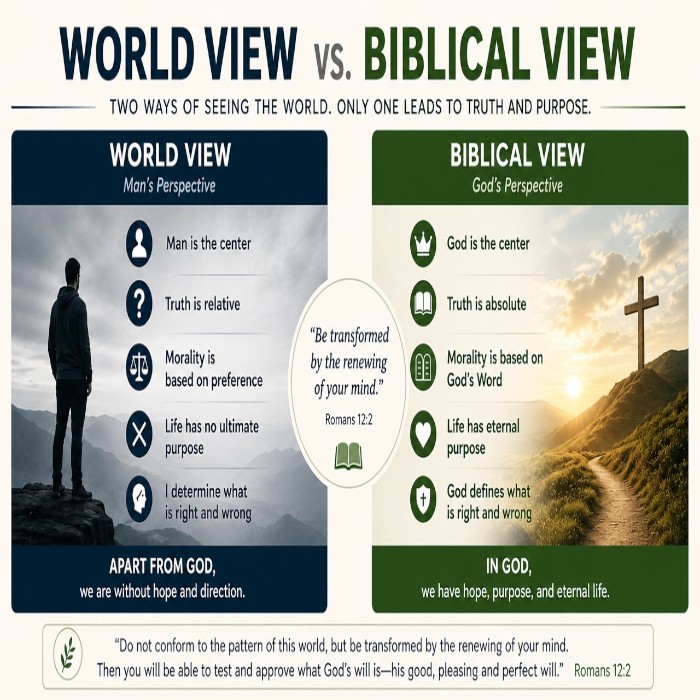
The lesson that I have been assigned is pertaining to our world view.
Now that was that's always something that like heard in sociology class in college. And you don't it's not something that you regularly think think about. But when you really sit down and ponder it, it's a person's worldview affects everything that they do.
If you look at a cultural difference, it is oftentimes rooted in the worldview. And I'll try not to chase rabbit. But having lived outside the U.S.
oftentimes it's easier to notice a worldview when when you're kind of in the abstract. Thus, it's oftentimes difficult for us to notice our own world worldview because we have it. We've always had it. Most everybody around us has it. And so that's kind of standard. And the specific aspect of that I have been assigned is our view of God, about God being a distant God versus God being an active God. Now, a few years ago, a team of researchers led by a guy named Christian Smith, and you may have heard of this before I had read it a few years ago, came up with a way to describe the beliefs of many people, even who consider themselves Christians.
And it's a big three word thing. Moralistic, therapeutic, deism. Has anybody else ever heard of that? Or is that just kind of okay? The. The idea is there's a few basic tenets. Number one, God exists and he created and ordered the world and in general kind of watches over human life. Number two, God wants people to be good, nice and fair to each other, as the Bible teaches and as most religions teach. Number three, the central goal in life is to be happy and to feel good about yourself.
Number four, that God does not need to be particularly involved in a person's life, except maybe when God is needed to resolve a problem. But in general, God is not actively involved in our lives. And fifthly, good people go to heaven when they die. Now, on the surface, that almost sounds good, right? Because there's some things in there that we can kind of get behind, right? We all ought to be good, we all ought to be kind. Yes, God did make the world. But then when you really start diving into that, as with most problems, the little bit of truth that's mixed in makes the false part even more dangerous, right? Because we get lured in. And the specific part of that we're looking at tonight is this concept of deism, that aspect of it that God isn't really particularly involved in our lives. Just kind of, he made the world, he made all these laws up. And if we go along with these laws of nature and everything, he doesn't really manage everything. Now, again, as someone who has lived outside of the West, I noticed that we in the west are very prone to this kind of thinking.
And some of it is because of what we've been able to do with this line of thinking, right? This line of thinking of science. And there are laws and repeatable experiments.
If you did an experiment today and then you repeat that experiment tomorrow, you'll get the same result. Other places in the world, they don't quite view that. I was living in Tanzania. I was at a preacher friend of mine's house and we were out doing Bible studies. And he said, hey, come by for lunch. And so me and a couple of his adult children, not little kid children, adult children were there. And a soccer match is on. And over the course of lunch, one team came back and scored like three goals in the space of like 15 minutes. And I was like, wow, that's awesome. And this adult child of a preacher friend of mine, raised in the church, faithful Christian, knows a lot, says, yeah, that's probably a demon. I'm like, what? Said, yeah, there's probably a demon on that field that's caused him to score.
Now, you know, I don't know a whole lot about soccer, but I'm trying to think of, okay, strategy and did they sub in a good player. But that was not what came to her mind.
Her mind was different.
It wasn't that Western kind of scientific thing. It was, oh, there's got to be some kind of force moving on that field that's making that team score and that one not.
So that kind of opened my eyes to, wow, this worldview thing is a real thing.
It really is a thing now.
And I'm going to try and manage time. Well, what are some ways. What are some things about deism that are attractive to us? And again, this is a Bible class. When I ask a question, I'm not. It's most of the time not rhetorical. I really am looking for answers. What are things about deism that are kind of attractive?
What makes us. Just be honest. There's a lot of people who kind of. I mean, a lot of our founding fathers were deists, if you read what they wrote.
What about deism is attractive to us? To us humans?
[00:06:51] Speaker C: Well, what you described, like, change or anything. I can.
[00:06:56] Speaker B: I'm just a good person. Exactly. Good is good enough. Good is good is good enough. I can just be basically good and I don't have to really fine tune anything. I'll just, you know, don't murder, I won't steal, I won't rape, I won't pillage, and I'm all right. What else about deism is attractive to folks? God's there for you when you need it. Yes, but not.
I don't have to deal with him all the time. Just. And we'll get to that here, here in a minute.
So let's look at a false. The false story, this false idea in a couple of biblical examples, and then we'll look at the correct side of it. First Kings, chapter 18. I wish we had time to go through all of it. This is when Elijah is there with the prophets of Baal, all 450 of them. You know, he had prayed that it would not rain. It did rain for three and a half years. And then God sends him to go deal with the wicked King Ahab and these prophets. He says, look, meet me on this mountain, meet me on Mount Carmel. And then we'll kind of have a face off, right? And he says, look, we'll each choose a bull and we'll cut it up and we'll put it on the altar, and we'll both pray to our God, and we won't put any fire on it. And the one that answers with fire, he's the real God. All right.
Verse 25. So Elijah said to the prophets of Baal, choose one ox for yourself and prepare it for you, for you are many. And call on the name of your God, but put no fire under it. Then they took the ox which was given them, and they prepared it and called on the name of BAAL from morning until noon, saying, o baal, answer us. But there was no voice, and. And no one answered. And they leaped upon the altar which they had made. And it came about at noon that Elijah mocked them and said, call out with a loud voice, for he's a God. Either he's occupied or gone aside or he's on a journey and perhaps he's asleep and needs to be awakened. So they cried with a loud voice and cut themselves according to their custom with swords and lances until the blood gushed out on them. And it came about when midday was past that they raved until the time of the offering of the evening sacrifice. There was no voice, no one answered, and no one paid attention. Now, ancient paganism, which is what they practiced, was actually rather similar to deism, because in ancient paganism, the gods, instead of us being made in God's image, the ancient gods were made in our image. They were very petty, they were very egotistical, they were very, very spiteful, and they basically didn't care about what happened on Earth or. Or about people unless you did something to get them wound up. Right? Which is why the nature of pagan worship was you had to do this big spectacle thing, right?
We see that with ancient Molech worship that you see in the Old Testament, right? I'm gonna burn my child. I'm gonna really make Molech look at me because I'm gonna burn my baby for him. We even see it in even North American. You look at ancient civilizations like the Mayans and others that sacrifice large numbers of people to their God. And that was that pagan philosophy that the gods really care unless you did something really, really big. Well, you see this with these prophets of BAAL working themselves into a frenzy, hours and hours and hours, cutting themselves, and blood's going everywhere, trying to work themselves up to try and make BAAL do something. Of course he didn't do anything because he's not real. And then you pick up there in verse 30 with Elijah, and he Calls the people to him, and, I'm going to try and shave this down for time's sake.
He rebuilds the altar.
He made a trench around the altar large enough to hold two measures of seed. He arranged the wood, cut the oxen pieces, laid it on the wood, and tell them, fill four pitchers with water and pour it on the burnt offering and on the wood. Do it a second time, do it a third time. And the water flowed around the altar and it also filled the trench. Now, when it came about that, it was time to offer that. Let's pick up in the middle of verse 36 and notice the difference between Elijah's prayer and what they did, oh Lord, what the God of Abraham, Isaac and Israel today. Let it be known that thou art God in Israel and that I am thy servant, that I've done all these things at thy word. Answer me, O Lord, answer me. This people may know that thou, O Lord, are God and that thou has turned their heart back again. Pause again.
Compared to what they did, it was very simple prayer. He didn't rant, he didn't rave, he didn't yell, he didn't scream, didn't cut himself, didn't flail around. He just simply prayed. And then you get from verse 38, and the fire of the Lord fell and consumed the burnt offering and the wood and the stones and the dust and licked up all the water that was in the trench. And when all the people saw it, they fell on their faces and they said, the Lord, he is God. The Lord he is God. Notice the difference in philosophies, or we might say now even worldviews between those two groups. Prophet BAAL thought, you got to work this big thing up and maybe BAAL will answer.
Elijah knew God, Elijah knew God cared and God was involved. And when he prayed, he knew God was going to answer him.
Now let's move forward to the New Testament. Let's go to Mark, chapter 15.
We're gonna read verses 29 through 32. Now, Jesus is on the cross at this point.
Hopefully all of us know know the story very, very well.
He is there because he will not refuse to recant who he said he was. He is crucified with Those two, those two criminals. Verse 29. And those passing by were hurling abuse at him, wagging their heads and saying, ha. You who are going to destroy the temple and rebuild it in three days, save yourself and come down from the cross. Pause notice here they're putting conditions on.
Okay, here's how I'll believe in you. If you do this now. Keep that in mind.
Verse. Verse 31. In the same way, the chief priests also, along with scribes, were mocking him among themselves and saying, he saved others. He cannot save himself. Let this Christ the King of Israel now come down from the cross so that we may see and believe. Again. Pause again.
They're putting conditions upon God. You do what I think you ought to do, and then I'll start believing in you.
Notice how they're trying to control God?
If you are who I want you to be, then, yeah, I'll go along with it.
Okay. Do you think they would have even
[00:13:51] Speaker C: believed if he would have done what they said?
[00:13:53] Speaker B: I don't know. Maybe, maybe not. But I think that's how we pacify themselves.
And I was actually talking to someone recently about.
They had a problem with some of the things that God allows to happen on the earth, and they made a big thing about that. But the longer I talked, the more I realized that wasn't really the reason. It was this other reason. That was a reason that they had a problem.
But in their mind, that was what they were telling them themselves. Not true. I don't know if they would have bowed down to him if he had come off the cross. But I think in their mind, and I think that gets to the root issue of this deism is we. We want God on our terms. We. We want him the way we want him to be. Bless you twice. Yes, go ahead.
[00:14:45] Speaker C: Just. Just to answer that, I don't. I don't think that they would have.
I mean, you look at all the. All the many things that he did to prove his power.
And like, they blamed it on, you know, him being. Him being a demon, him, you know, all these different things. And like, from the parable that he tells about the rich man and Lazarus, you know, the rich man says, send Lazarus back to my family. They'll see him raised from the dead and they'll believe.
And he's told no, that they won't, even if he comes back from the dead. They've got all the prophets, everything that's happened in the past, and they still don't believe.
And. And I mean, you can look, I mean, especially the Old Testament is full of this, where the Israelites, you know, they see. They see God do the ten plagues. They witness it with their eyes. And then they get to the Red Sea and they're ready to give up. They. They see him open the Red Sea for them. They get through on dry ground and see him crush the. The Egyptian army in The Red Sea.
[00:15:47] Speaker B: And.
[00:15:47] Speaker C: And like, five days later, they're making a gold calf.
And. Or they're complaining because they don't have food that they like. You know, God provides manna for them miraculously every day, and they complain that it's not meat.
And so you can see just example after example.
[00:16:06] Speaker B: And.
[00:16:06] Speaker C: And it's easy to tell ourselves, you know, well, if I saw that, it'd be easy to believe.
But you see example after example that it's just part of the human condition, that it doesn't matter what miraculous things we see.
It's not gonna convince us.
[00:16:22] Speaker B: And it comes back to our worldview, really, because it's this idea that that's the lie that we tell ourselves, but we're not willing to admit, okay, I'm gonna change to whatever it is God says do, and that's what I'm gonna do. Whether it's we die here wandering in the wilderness, but that's God. You know what I'm saying?
That's it. And here at the end of verse 32, and those who are crucified with him were casting the same insult at him. I have oftentimes been puzzled by that, because no matter how bad I had been, not sure if I'm being crucified as well, not sure I'm gonna be yelling at the guy who I think is probably better than me. But they.
But it goes back to just. What you were saying is God wasn't doing what they wanted him to do, and so it wasn't working. When he was doing the 10 plagues, they were cool with it. When he wasn't doing the plagues, all of a sudden, they weren't.
I used to illustrate this as people wanted to parachute God, you know, a parachute in case things don't work out. Oh, I'll just pray and then it'll be okay. I. I taught the college age last week, and I used this. This phrase, and maybe it works for y', all, too.
Everybody, video games. And you kept enough, like, game coins or whatever to respawn in case you got killed. And you always kept that certain amount. Oh, I need 500. So if I get. If I get shot, I can respawn. And so you always kept. Anybody else do that, or is that just me? Okay. A lot of people want a game coin. Got.
Yeah, I got baptized at camp when I was 15.
Yeah, I go to church a couple times a month.
Yeah, I try not to use the big cuss words, and I try not to shoot anybody, but they're not really. I Mean, honestly, that's how big. Right, right.
And that's.
That's how people think. And they want God to be that.
And that's not who God is.
And so now let's look at the true story. And I have several passages for us to look at. Not sure we're going to get to all of them, but we will try. Psalm 46.
This is a Psalm. Oftentimes we will quote verse 10. It is sometimes engraved on things, but when you really look. And I'm going to kind of quickly go through the whole Psalm, it's just 11 verses. God is our refuge and strength, a very present help in times of trouble.
Therefore we will not fear. Though the earth should change, and though the mountains slip into the heart of the sea, the. Though its waters roar and foam, Though the mountains quake at its swelling pride.
Let's pause right there.
I wanna try as much as possible to make this.
What the psalmist is writing here, hit home on us. If we got up to go to work tomorrow and looked and Montesano Mountain was not there, if it was flat, we would freak out, wouldn't we? Let's be honest. We would freak out.
Right?
The closest thing I can get to this on a national scale is. And some of y' all remember, this was 9, 11.
I can remember everything was different.
And every time I remember the first flight I took after that happened, I'm looking around. Didn't y' all do it? Any of y'? All? And not judging anybody, not trying to be. But the whole time you're like, okay, it's just gonna happen to me. Everything was different. And the psalmist says, look, even if a mountain is gone, God is still God.
Even if the river doesn't flow, God is still God. Even if the ocean is not there anymore, God is still God. Verse 4. There is a river whose streams make glad the city of God, the holy dwelling places of the most high. God is in the midst of her. She will not be moved. God will help her. When morning dawns, the nations made an uproar, the kingdoms tottered. He raised his voice. The the earth melted. The Lord of hosts is with us. The God of Jacob is our stronghold. Notice God is always working for his children. He is always doing things on behalf of his children. This is not the God of deism. This is not the God of paganism. This is a very active God. Come, behold the works of the Lord who has wrought desolations in the earth. He makes wars to cease. To the end of the earth he breaks the bow and cuts the spear in two. He burns the chariots with fire. Pause right there. Notice he's reminding us of all the things that God has done that God is doing. He will always do that. And then we get to verse 10.
My version says, cease striving and know that I am God. I will be exalted among the nations. I will be exalted in the earth.
Anybody else have a different reading of verse 10?
Just read it out.
Be still. Anybody got a different one?
Literally, that phrase, be still or see, striving literally means let go, relax.
And the best way I can illustrate that is, you know, when you're nervous, when you're stressing, when you're. You're tensed up, right? You're like this. And God's literally saying, let go.
Let go. I've got this.
Verse 11. Lord of Hosts is with us.
The God of Jacob is our stronghold. God does not leave us alone.
God does not reject us. God will always be there with us.
Exodus chapter 14. Again, I'm gonna try and go as quickly as we can.
The children of Israel are.
This is the last plague that God is sending. He has sent that last plague, the death of the first firstborn. Pharaoh says, get out. Go. They. They travel. They're at the edge of the red Sea.
Exodus 14, verses 13 and 14. But Moses said to the people, do not fear. Stand by and see the salvation of the Lord, which he will accomplish for you today. For the Egyptians whom you have seen today. You will never see them again forever. The Lord will fight for you while you keep silent. Notice the difference in that description of God and the pagan or the deistic view of God. That I got to work myself up so God will care about me, that I've got to do some real big thing so God will take notice, and God will know. God says, you be quiet.
I've got this.
And all that night, the wind blew. And I can just imagine in my. My mind, when the sun started to rise the next morning, they looked out, and all of a sudden, there's walls on either side and the ground is dry and they get to walk.
We don't have time now, but read Exodus chapter 15, especially verses 1 through 18 tonight or at some point this week. This is the song that Moses sings afterwards. And he talks about what God has done. And then poetic and very strong graphic description.
He talks about how God is a warrior. Verse 3. The Lord is a warrior. The Lord is his name. The imagery is that God is strapping on his sword to protect his people.
Okay, we need to remember that the presence of God, the literal, active presence of God in our lives, is one of the greatest and really one of the most foundational aspects of the Christian life.
And that needs to be our worldview. Now, when I say God is with us, I really mean literally. Like, I lost my brother back in November. Part of James will always be with me, but he's not really with me. It's memories, and they're wonderful, and they're great. And I get to tell stories. And one of the great things about being old is I've forgotten stories and I remember them and I tell my kids and we all get to laugh, and it's great.
He's not literally with me, right? His memory is, and that's great, and it's wonderful, and it's awesome.
God says, no, I'm literally with you.
You don't go anywhere. I'm not.
I don't care, wherever it is.
And I'm telling you, that is one of the most comforting things.
And again, I'll try not to chase a rabbit hole and get way too personal, but that is one of the most comforting things about being a Christian.
When the boss walks in and says, sorry, we're going in a different direction.
When all of a sudden you.
You sign those papers that says you're not married anymore because the choices of somebody else.
When the doctor comes in and says, oh, we're sorry, there's nothing we can do for your family member.
We're just waiting, knowing that God is not just sitting way up in heaven looking down, oh, Ben's got a problem.
No, God is with us.
James, chapter 5.
We oftentimes quote verse 16, which is very important, and it is powerful. But let's look at the this whole section, verses 13 through 16. Is anyone among you suffering? Let him pray. Is anyone cheerful of him? Sing praises. Is anyone among you sick? Let him call for the elders of the church and let him pray over him, anointing him with oil in the name of the Lord. And the prayer offered in faith will restore the one who is sick. The Lord will raise him up, and if he has committed sins, they will be forgiven him. Therefore, confess your sins to one another and pray for one another so that you may be healed. The effective prayer of a righteous man can accomplish much if we have a need. God says pray.
Now, I grew up in the church, as a lot of y' all did, and prayer.
You know, we always prayed before we ate. We always prayed, you know, prayed in the church, prayed in Bible class when you as an adult. When you sit down and ponder that the infinite, omnipotent, omniscient, omni, everything, those words that I can't spell, God sits and listens to me.
And if it's in his will, he will give me what I've asked of Him. And even if I don't understand when the answer is no, I know that he's got my best interest at heart.
Knowing that, again, that's what being a Christian is about.
That's what everyday living the Christian life is about, is knowing that God is not just sitting way up in the sky, but he is with us. Ephesians, chapter three.
Told you I had several. And we'll keep reading till the bell rings. Ephesians 3, 20, 21.
If you mark in your Bible, mark these two. Now, to him who is able to do exceedingly, abundantly, beyond all that we ask or think, according to the power that works within us, to him be the glory in the church and in Christ Jesus, to all generations, forever and ever. Amen.
Notice he is able to do exceedingly, abundantly, beyond all that we ask or think, according to the power that works within us.
Sometimes, and I can't help but chase a small rabbit here, sometimes we get this idea that if God does something, it has to be a miracle.
And I'm. The whole miracle conversation is a whole nother thing to have. But just because it's not a miracle doesn't mean that God didn't do it.
Does that make sense?
And these verses, I think, reinforce that idea.
You know, when I pray for a job and I get a job, that's not necessarily a miracle. But is it an answered prayer? Yes.
When my child is sick and I pray that my child gets better, and we go to the doctor and get medicine and my child gets better, is that a miracle? No. But is that God doing it? I think yes.
Just because it's not some big grandiose fire from the sky like Elijah's day doesn't mean it's not God working.
Because again, he is active in our lives. He is with us. He is able to do more than we can even understand by things that we don't understand more because they're already at work in our lives.
Romans chapter 8. Let's see if we can get.
And we could spend the entire class on this passage. Romans 8, 28.
And we know that God causes all things to work together for good to those who love God, to those who are called according to his purpose. Notice God causes everything to work out for good. God is active in our lives. Verse 31. What shall we say then to these things? If God is for us, who is against us? If God's on our side, who can be against us? Now, this doesn't mean that everything is going to always come out well.
Right in the middle of this big section. Starts in verse 28, runs through verse 39, you get verse 36.
Just as it is written, for thy sake we are being put to death. All day long we are considered as sheep to be slaughtered. Does God's providential hand always mean that everything works out just the way we want it to? No. Does not.
That doesn't mean God isn't active. That doesn't mean that God isn't working his will. That doesn't mean good's not going to come out of it.
But that does also means. It doesn't mean that everything's going to be good.
Okay? Because it's not always.
And God's telling us that here.
You know, I've never been a sheep that's been slaughtered, but, you know, it doesn't sound pleasant.
And then we get to verses 38 and 39. For I'm convinced that neither death nor life, nor angels, nor principalities, nor things present, nor things to come, nor powers, nor height nor or death, nor any other created thing shall be able to separate us from love of God, which is in Christ Jesus our Lord. There's nothing that we can do that will separate us from God's love. God is always with us and we can choose to leave him and thus forfeit our salvation. The Bible is clear about that. But as far as what happens to us in our lives, there is nothing that can happen to us in our lives that can separate us from God's love for us.
There's a couple of other. Yes.
[00:31:46] Speaker C: Some of these challenges, some of these really difficult things that we can't comprehend to really get closer to God in the first place. Right.
[00:31:54] Speaker B: 100. Yes.
[00:31:56] Speaker C: We get closer to each other as Christians in turn. Helps us get closer.
[00:32:01] Speaker B: Yes.
[00:32:01] Speaker C: To God.
[00:32:03] Speaker B: I don't know.
[00:32:04] Speaker C: We just build that relationship and it strengthens and gets us through.
[00:32:08] Speaker B: I will try not to be too descriptive for my children's sake, but in the middle of all the mess that we had going on, I had.
I had lost almost everything physical that I had.
Books, guns, family heirlooms.
Was about to lose my marriage.
I was having health issues and there was other stuff with.
Couldn't be with my kids all the time. And because the other people's choice is not mine. Broken system, whatever And I still remember, even in the midst of all that.
Again, I'm not going to ask for that to happen again.
But I've never felt closer to God than at that moment, than sitting in a Waffle House at 4 o' clock in the morning with a Bible and a notebook, writing down my thoughts because I couldn't be in the house with my kids. There's a phrase that Brandon used last week when he was in. In his sermon, complain or confess, and that stuck with me. That's that. That. That hit hard.
First Corinthians, chapter 10, verse 13. And if, while I'm getting this one, if somebody would turn to Philippians, chapter 2, verses 12 and 13, maybe we can get both of these in. First Corinthians 10, verse 12. Let him who thinks he stands take he, lest he fall. Verse 13. No temptation has overtaken you, but such God is faithful, who will not allow you to be tempted beyond what you are able. But with the temptation will provide the way of escape. Also that you may be able to endure it. Every single time that we are tempted, God is actively on purpose, specifically giving us a way to not fall to that temptation.
And if we will pause and really examine if we can catch ourselves. Okay, what is God giving me here to try and get me not to do this sometimes?
Again, don't misunderstand me, I'm not saying more than I'm saying sometimes it'll almost seem miraculous. Not saying it's miraculous, but it'll almost seem that way.
Oh, wow, this person called me right now.
This person sent me a text right now.
Oh, this popped up in my feed. Not that you mean this book. I happened to fall off the shelf because it wasn't stacked properly. You know, it's. And that's God doing it now. One, one more. And I think our time's going to be up. Philippians 2, verses 12 and 13. Oftentimes I have preached and quoted verse 12 profusely, and I completely did not notice.
The rest of the sentence is verse 13. Somebody read verses 12 and 13 of Philippians chapter 2.
[00:35:15] Speaker C: Therefore my beloved and you have always obeyed. So now, not only as in my presence, but much more in my absence, work out your own salvation with fear and trembling, for it is God who works in you both to will and to work through his good pleasure.
[00:35:30] Speaker B: If you just read verse 12, it makes it look like it's all up to you. You got to work it out.
You got to work it out. It's you.
If you just read verse 13, it sounds like it's all God, right? For it's God who is at work in you to will and to do his good pleasure.
The point is, yes, we have to do things. Absolutely salvation is not.
We do have to make the choice, but God's also helping us make that choice.
He's also at work actively in our lives, in every single moment of our lives. Never forget that. God is not distant. He is not some foreign thing floating up in the sky, playing chess with the earth. That's not God.
That is not God. Let's close out with a prayer and then we'll be done. Father, thank you so much for being our God. For being a God that is close, not one that is far away. Thank you so much for your son. Thank you so much for what he did for us. Through that cross and through rising from the dead.
Help us to remember that you are with us every single moment of every single day.
Father, we love you so much. In your son's name we pray. Amen. Thank you all so very much.