[00:00:00] Speaker A: Hey, thanks so much for listening to this message. My name is Jason and I'm one of the ministers here at the Madison Church of Christ. It's our hope and prayer that the teaching you hear today will bless your life and draw you closer to God. If you're ever in the Madison area, we'd love for you to stop by and study the Bible with us on Sundays at 5pm or Wednesdays at 7pm if you have questions about the Bible or want to know more about the Madison Church, you can find us
[email protected] be sure to subscribe to this podcast as well as our Sermons podcast, Madison Church of Christ Sermons. Thanks again for stopping by. I hope this study is a blessing to you.
[00:00:38] Speaker B: Well, good evening everybody. Certainly a pleasure to be here this evening with you.
Like John said, it's a little bit of a unique quarter because this will be the first and last time you'll see me.
Hopefully that's not too good of a thing, but we'll see here at the end of class.
For those of you who don't know me, my name is Adam Chalmers. I'm in the Young Married Connect group. Been a member of Madison for almost four years. Me and my wife Cynthia got married right out of College in 2020 and have been here ever since. See a lot of familiar faces, not so familiar on the name. So I was thinking about it. I assume that I know a lot of y' all pretty well, but I realized that I guess I know a lot of the preschool families because they were in the Young Marrieds and my fam group leader. So not a lot of the teen parents, but a lot of y' all like to get to know a little bit better. So I'm excited for the opportunity to get to be here in class with you guys tonight. The topic we have is Individual Rights versus Freedom in Christ.
This is something that I think is going to be a little bit challenging.
One of the things whenever I have an opportunity to teach teenagers or younger that I try to pass on because it's something that I had just a big epiphany when I was in college thinking about this and I'm sure all of you have had as well as you get older, you're taught a lot growing up that you got to choose between right and wrong, between good and and bad, and that those are the really hard choices to make in life. And while certainly you do choose a lot between right and wrong, good and bad, and there can be very hard decisions where you're having to choose between Those things. I've often found, at least in my life, that the really hard decisions are not good and bad. It's good and godly.
There are plenty of things in this world that can be good.
But when we compare it to our faith or in the right context, when does that turn into maybe not the most productive thing for us to have?
And that's really where I think we're going to have a conversation tonight. Before we do that, I want to show you this picture.
And I just want to ask you, when you think of the idea of individual freedom versus freedom in Christ and you look at this picture, what connection comes to your brain?
So these are guinea pigs. At least I hope they're guinea pigs. That's what came up when I searched guinea pigs on Google stock images.
And I'll be honest, I know this is probably not the best way to start our class relationship. It was a little bit of a trick question because this is actually you. You're the guinea pigs. As John said, we're teaching this class 10 times, nine times.
And so one of the things that I thought would be kicking myself about if I didn't do is ask for your feedback. So this is actually a QR code link to just a quick survey. You can do it now. I'll post it at the end of class. Just what did you like about our discussion? What did you not like about our discussion? Myself and Vic Pratt, who's teaching alongside me this quarter, are going to be doing this, like John said, every, every week.
So I'd love to know. It's. It's a really rare opportunity. Most of the times, you know, you teach one lesson, you move on to the next one.
This lesson will probably look a lot different ten weeks from now.
So if we don't get to something tonight or if you have something about this that you're very passionate about and we don't get a chance to talk about it tonight, I'd love to know that. And so we can model that class.
But yeah, and I also just kind of wanted to throw a random picture of getting pigs up and see what your brain's winding connections. And those are some really good connections. But as we're looking through this, the title of this quarter, I want to take just a second to do introductions, since I am the first week.
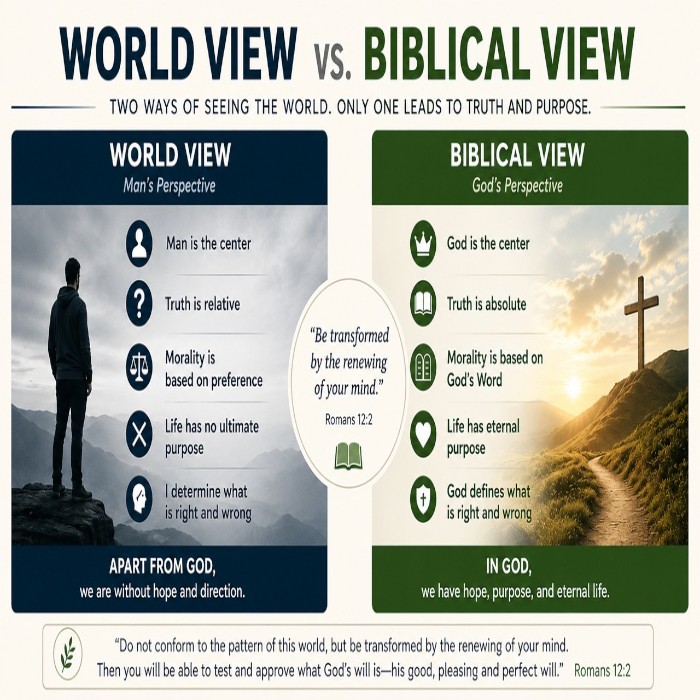
It's technically called Worldviews or Lenses of Worldviews.
And not only is that this quarter, but actually our elders have told us that this is the whole year back to Q4, or I guess Q1, starting last December.
The entire kind of overarching theme for that quarter all the way through Q4, the end of this year is worldviews. So when we did our class On Genesis for Q1, that was the idea of we need to know where we come from to understand where we're going and how to, you know, the beginning of everything, to build a foundation for the worldview.
Last quarter, talking about the walk of Jesus, obviously needing to know about Jesus, how to be with Jesus, how to be like Jesus, to shape our worldview. This quarter's a lot more current issues, current debates. And so a lot of it is themed as this versus this.
And some of them are, you know, just a clearly something that we would say like, yeah, that doesn't fit into our Christian worldview. I was talking earlier before class and I think one of them, which is a fantastic topic to talk about is, you know, guilt versus grace or something along those lines. But probably not a lot of us are going to be on the pro guilt side of that.
This one is a lot more interesting to me because it's not necessarily an argument of like our individual rights bad.
And I'm not going to stand up here and say like we should not have any individual rights certainly.
And I do think this is going to be shaped through the different contexts of our life. Now the whole point of this quarter, just to give you guys a spoiler alert, will be that the Bible, our faith, scripture, should be the number one primary driver, the primary lens of how we view our world.
But within that there are other secondary lenses, our background, our culture, our upbringing, life experience that are going to shape how we view different topics.
And so just because all of us should have the primary worldview driver of Scripture does not mean that we're all going to agree on everything at every point. And that's totally okay. And so it's a good thing. And it's important to realize as we're talking through this, this is really especially my class, at least I guess I can't speak for everybody else, really, a discussion based class, because we're all coming at this topic from a slightly different perspective. Some of us may be from completely different perspectives.
And so when we're talking about this, our background is going to influence our lens on which we view this through.
So as we get into specifically our topic, which is individual rights versus freedom in Christ, let's define our terms. What are individual rights? Either what are specific ones or how would you define broadly the idea of an individual right?
Okay, so property is an individual right at Least the right to acquire property.
Speech is an individual right.
Freedom of freedom practice, religion is an individual right.
Right to vote. We got the First Amendment and we'll just go down the Constitution.
So really good answers and honestly, it kind of ties into what I want to talk about because a lot of what we as Americans in 2026 derive our idea of individual rights from is the colonial Americans who divide. Who got that from the idea of the Enlightenment. And I do have a history degree and I'm not actually a history teacher anymore, so generally I like to tie history into this just to feel like I made my degree worth something. But we're not going to get into a super deep history lesson on the Enlightenment.
But it is important to realize that a lot of our ideas about this people have written on extensively.
These are a couple of quotes and ideas from non American, but still people who were influenced names like Jefferson and Madison on the idea of individual rights. And really as you get into the Enlightenment, there's a lot of people, you have Rousseau, Blackstone, John Locke is probably the most famous one who most directly impacted the American viewpoint. He had the famous quote saying that the three fundamental, three fundamental rights are life, liberty and property, which Jefferson co opted in the life, liberty and the pursuit of happiness.
But this, these are just a couple of quotes that kind of encapsulate the idea of individual rights as it applies to the founding of our nation, which generally has shaped a lot of our worldview, especially if you are from America, grew up in America. Blackstone says it's better than ten guilty persons escape, than one innocent suffer. Kind of the idea that the ultimate injustice is for someone who does not deserve punishment or someone who does not deserve to have their rights deprived, having their rights deprived from them. Kind of the ultimate injustice is that your rights are taken away.
Obviously a very, very interesting worldview and thought. When we get into this thinking about the idea of Christ.
And then you have Rousseau, who his whole philosophy is this idea of the social contract that when we were born by the nature of our birth, we sign this contract to be a part of a society. And he says man is born free and everywhere else he is in chains. This idea that we are born as free creatures with full rights and the government comes in and imposes rights upon us.
And so a lot of the Enlightenment thinkers that then influenced the American Revolution, which obviously influences how we view this topic, are very much kind of laissez faire, live and let live. I don't want to have my rights infringed. What we might think of as like a modern day libertarian and not trying to get too political, but just thinking about our worldview.
Then there's another idea that we see with a modern thought on individual freedom, which really is the idea that consent is the ultimate driver of rights.
If you have two adults and they agree to it, you should be able to do that to two consenting adults can do whatever they want to do, or one consenting adult can do whatever he wants he or she wants to do, as long as you're not harming anybody else.
This was written from the Decision Planned Parenthood vs Casey, which was in the 1990s, which helped kind of give more rights or more freedom to abortion clinics. Backing Roe vs. Wade and Justice Anthony Kennedy. Kennedy, fighting and agreeing with this decision, said that the heart of liberty is the right to define one's own concept of existence, of meaning, of the universe and of the mystery of human life.
So the idea that our individual rights mean that all of us should be able to define whatever we truly believe to be right or just in the world and live our lives based on that, as long as we're not directly harming somebody else.
A more modern book, Heidi Herd says consent is a moral transformer. It turns a trespass into a dinner party, a battery into a boxing match, and a theft into a gift.
The idea that there is no real true moral standard or no true deprivation of right, as long as people consent and agree you should have the right to do it. The government, religion, whatever, should not be able to tell you you cannot do something if it's not harming anybody else. Ultimately, what boils down to what I would argue is that our common 2026 worldview for the average person that is not necessarily influenced by religion is if it is legal and it does not harm anyone, I should be able to do it.
And again, this is where it gets complicated, because I'm not going to say that necessarily this is the worst philosophy ever. This is in many cases true.
We have a whole popular wing of political thought, the Libertarian Party, which would argue this point.
But that is where we see on the idea of individual freedom, this idea that if it's not harming anybody, if it's legal, if we consent, I should be able to do it. And that should be the number one determination of what we should do. Not really is it, should I do it? What are the implications of it? Just, can I legally have the right to. To do it?
I think there are definitely areas where we apply this in our own lives.
Maybe some that we wrongly apply.
Can you think of any areas in your life where really the only thing you were thinking of is, is this legal or is this illegal?
[00:12:39] Speaker C: There's a big debate on certain drugs
[00:12:41] Speaker B: being legal or illegal, and they definitely cause harm. And they're still being, like, in the eye of being legalized.
[00:12:47] Speaker C: Right.
[00:12:48] Speaker D: I would argue that it's wrong regardless, obviously. But is that kind of what you're looking for?
[00:12:53] Speaker B: Yeah, well, I mean, I'm looking.
I'm looking for whatever y' all got. It's interesting. It's interesting conversation. But, you know, when you. When you think about something like alcohol for 120 years, it was legal. So if we're applying this standard, we can do it. We have prohibition, okay, we shouldn't drink alcohol anymore.
Now we can do it again.
So if you're going by that standard, it's not necessarily your decision of, is it good for me? Has changed. It's just, do I have the ability to do it?
We could look at, again, not to get too political and all of that, but look at the abortion decision. For a while, abortion was illegal. It gets legalized. So we can do it. Now it's up to the states. So you could drive in Alabama, and if we're applying this standard, abortion's wrong. If we drive up to New York, abortion's right.
It gets a little bit hairy.
It's complicated. Because I would argue that our culture, especially in America, is so ingrained on the idea of what do I have the right to do? What do I have the legal ability to do?
And we see culture in the Bible that is very, very similar to that. And it's where we're going to spend a lot of our times in First Corinthians, and we're going to see how Paul addresses this, and we see him address it in a couple of different ways. So Paul in the First Corinthians, which is actually, is commonly known, actually Second Corinthians is the second letter to the Corinthians. We don't have the real First Corinthians, but in his response to the Corinthian Church, he addresses several things. And if you have read First Corinthians or know about 1 Corinthians, there's a lot of stuff going on here, a lot of crazy things going on in the church at Corinth.
In First Corinthians 6, though, it's kind of a really interesting thing because he's talking about something that seems, in my opinion, a little bit, when you first read it, kind of Mundane, because it's about lawsuits. And I'm not a lawyer. I have a little bit of like interest in legal proceedings, as you can tell probably from my history background. But I wouldn't necessarily think like when you're thinking about issues that are just like super controversial in the church that are going to drop a bunch of emotions like legal litigation, that's the one we're going for. But yet Paul spends 1 Corinthians 6 laying out this grievance. And what he's heard from the church at Corinth is, I have the right as a Roman citizen to sue my brother.
So you had, it seemed, appears to be different cases going on within the church where somebody would wrong somebody else. And instead of trying to settle it themselves, instead of maybe going to the elders, instead of going to other members and selling among themselves, they're immediately going into litigation. And so you imagine you're in a Roman court and all of a sudden all these Christians are coming and this Christian suing this other Christian and this Christian is suing this Christian about what it seems, it appears to be obviously not inconsequential things, but maybe not the most crazy things, maybe slightly mundane.
And we see Paul say a phrase which he's going to Repeat several times.
First Corinthians 6, verse 12, Everything is permissible to me, but not everything is beneficial.
Everything is permissible for me, but I will not be mastered by anything. If you're reading that in your Bible, you're going to see quotes. He's actually quoting them, saying, well, it's legal, I can do it. I have the right as a citizen to sue my brother. I can sue whoever I want to.
And Paul's asking the question or he's making a statement. It's not always beneficial.
In 1 Corinthians 10, if we go over there, the same kind of statement is being made and this one is about, I believe it's idolatry. Yeah. So they're talking about different things going on within idolatry.
And he makes a statement once again, everything is permissible, but not everything is beneficial. Everything is permissible, but not everything is edifying.
And so this is, and we're going to talk about in First Corinthians 8 when this happens again. But talking about idols and you know, there were some people that were coming from that pagan background where that idol meant a lot to them. There were some people that were coming from maybe a more Jewish background or a non religious background where they didn't really take the idol seriously. And there was some tension. You know, it's very interesting, and I'm not the first person to make this point. I've heard it made here several times. But as I mentioned before, we all come from different backgrounds, but we are probably not nearly as diverse of a group of people as the church in Corinth.
None of them, or at the very least maybe very few of them, were born as Christians. A lot of them were born into different religions and they all converted.
I don't know about your faith background. I was born, you know, I've been a member of the Church of Christ my whole life. So I can say at least one of us has been a Christian, you know, been in the Church Christ their whole life. And that's our main worldview. These people, they were coming from all different walks of life and they were having all different types of worldviews. And so some things that were bothering one group of people, we're not bothering another group of people.
And Paul's addressing this idea in First Corinthians 6 and 10.
The idea of just because you legally have the right to do it as a citizen does not mean that maybe you should do it or that it is beneficial to do it. Not just can I, but should I?
And a lot of this is taken in context because Rome was at this point, a fairly similar, in some ways, culture to us from the standpoint of this idea of rights.
I remember the meme from a couple years ago of like, at least once a week an average man will think about the Roman Republic or the Roman Empire. So I'm sure some of you know about this. But Rome got worse off later on. You get. But at this point and before the. There was this idea of some sort of democracy, of a republic of people having individual rights.
We see Paul actually go through this in Acts chapter 22.
At the end of Acts 1, going into Acts 22, Paul's in the temple and he's basically giving an account of his life.
And at the very end, if I can get my thing to load right here. But at the very end of Acts chapter 22, Paul has kind of set his peace for a good bit.
He really goes in talking about Jesus. He gets the crowd riled up, and they get ready to go off and take him prisoner and kill him.
So in Acts 22, verse 22, the crowd listened to Paul until he made this statement. They lifted up their voice and shouted, rid the earth of him. He is not fit to live. As they were shouting and throwing off their cloaks and tossing dust into the air. The commander ordered that Paul be brought into the barracks. He directed that Paul be flogged and interrogated to determine the reason for this outcry against him.
Verse 25. But as they stretched him out to strap him down, Paul said to the centurion standing there, is it lawful you lawful for you to flog a Roman citizen without a trial?
On hearing this, the centurion went and reported to the commander. What are you going to do? He said, this man is a Roman citizen. Commander went to Paul and asked, tell me, are you a Roman citizen? Yes, he answered, I paid a high price for my citizenship, said the commander, but I was born a citizen. Paul replied, and those who are about to interrogate Paul step back. And the commander himself was alarmed when he realized that he had just put a Roman citizen in chains and then he gets released. And so there was very similar to. We have today a very right centered culture, where being a Roman citizen gave you certain rights.
Today, being an American, the idea of I'm an American, so we have these things, the right to life, the right to liberty, the right to property, freedom of speech, all the things that we can think about from the Bill of Rights.
So that culture, very similar to our culture, is a very, very individualistic, rights centered culture. And so we see from the church in Corinth that there is a problem going on here to where it's not so much, is this good? Is this right? It's just, am I legally allowed to do it?
Okay, so let's look at a specific example. Again, staying in 1 Corinthians 8.
This is a story that is fairly well known and we've talked about, but I think it's important to go through this story because again, this is something that we're probably going to have very strong opinions about and we can somewhat tie it back to, like modern political. And you might have very strong opinions on the idea of individual rights. And it's not necessarily. I don't want us to have like a political debate on how individual rights function in modern American culture for maybe issues that are very passionate and we might have disagreement on.
I think it's good to look at this through a purely spiritual, objective lens. And we see a great case study in Romans 8 over something that probably none of us are going to disagree on in 2026, which is the idea of eating meat sacrificed to idols, or at least something that we see commonly as a struggle within our life.
So going to romans, excuse me, 1 Corinthians 8, starting in verse 1, it says now, about food sacrificed to idols, we know that we all have knowledge. Knowledge puffs up, but love builds up.
The one who thinks he knows something does not yet know as he ought to know. The one who loves God is known by God.
So about eating food sacrificed to idols, we know that an idol is nothing at all in the world and that there is no God but one.
For even if there are so called gods, whether in heaven or on earth, as there are many so called gods and lords, yet for us there is but one God, the Father, from whom all things come and for whom we exist. And there is but one Lord, Jesus Christ, through whom all things came and through whom we exist.
But not everyone has the knowledge.
Some people are so still so accustomed to idols that they eat such food as if it were sacrificed to an idol.
And since their conscience is weak, it is defiled. But food does not bring us closer to God. We are no worse if we do not eat, and we are no better if we do eat.
Be careful, however, that your freedom does not become a stumbling block to the weak.
For if someone with a weak conscience sees you, who are well informed, eating in an idol's temple, will he not be encouraged to eat food sacrificed to idols? So this weak brother from whom Christ has died, destroyed by your knowledge, by sinning against your brothers in this way and wounding their weak conscience, you sin against Christ.
Therefore, if what I eat causes my brother to stumble, I will never eat meat again so that I will not cause him to stumble.
So a really strong rebuke here from Paul.
You know, really getting into the theology of it, which is, hey, I'm going to take a theological stance, me being Paul, you can eat the meat.
These other gods, they're not real. The idols they're sacrificing to are not real. It's just meat. You can eat it.
However, if you have somebody who's a new Christian, who their worldview is, they have spent their whole life believing that this is sanctified meat sacrificed to idols that should be treated in a certain way. And you come in and you just completely railroad them and kind of make a mockery out of that.
And their conscience is hurt and they're worried by it, and they're having this internal struggle.
Is your right to eat that meat really beneficial if it is harming another brother?
And I would kind of ask that question, but to be honest, Paul answers in the back half of it and says that that is sinning against your brother. And if I were in that situation, I would just not eat the Meat.
So Paul is very clear that you can eat the meat, but if eating the meat is going to cause your brother to sin, you'd be the sinner by eating the meat and causing. And stumbling.
And so it's this very powerful response to this idea of we have the freedom to do a lot of different things. And especially in 2026America, as you know, we have the freedom to do a lot of stuff.
A lot of it is sinful, but some of it might not be sinful. But is it beneficial? A couple things I want to ask, just because there were curious questions that stuck out to us.
Why do you think those that abstained didn't want to eat the idol meat?
Was it truly ignorance?
They didn't know.
Was it. They were wanting to honor their.
The God of the heaven, you know, one true God in the same way that they were honoring these idol gods.
Why do you think it was such an issue for them?
[00:25:39] Speaker D: Sonny taught Corinthians or was one of the teachers that did Corinthians. And I think he did the big Corinthians 8. And his story was that he and Joanna went to India to eat at the temple.
[00:25:53] Speaker B: Right.
[00:25:53] Speaker D: I think it was kind of a common thing to go to the temple. Temple to eat. And that meat was served to idols. And so his family not being Christians, you have this exact situation come up. Where does it make sense for us to eat and then potentially give off a different.
Maybe it has a different connotation for those who are Hindu or whatnot. Right? Worship those gods that eating that meat hasn't circumstances. So I know he, he said that that specific scenario just stood out. And then he. I think he said he didn't. He didn't eat. And I don't remember what doing good or not, but that, you know, maybe you abstain because of other people. Maybe you abstain because you're just so used to it and you're ingrained and you know, however you feel right, depending, I don't know, not sinning against your brother, not being a stumbling block.
[00:26:48] Speaker C: Such a.
[00:26:48] Speaker D: It's such a weird gray topic and it's difficult, but I think, you know, maybe they made that choice to not influence other people.
[00:26:57] Speaker C: Part of the, part of the problem is that back then that part of the worship of these idols was you would offer the food to the, to the idol. And then part of your worship to that idol would be you eat the food after you offer it to the idol. And so part of the. The problem with the people that come out of that is it's like you said, it's ingrained in their mind that eating this meat is worshiping, that it's the same thing, that it's part of the worship. It's like, it's like if we, you know, with, with like the Lord's supper, if you were to convert to some, something else then, and you didn't believe in God anymore, you thought that was wrong, then eating the Lord's, you know, eating crackers and eating grape juice together, like that would be the same thing to you.
And, and so eating, eating this meat that's been offered to those idols is the same thing to them as worshiping.
But, you know, us or to, you know, to the Jews, it didn't mean anything. Those, those idols aren't real. You know, you're not, it's not worshiping anything. It's just, it's just, you know, piece of stone. There's. So it doesn't matter. It's fine if I eat it. But to somebody who came out of that and converted to Christianity, it's. You're worshiping that idol by eating that meat.
And a lot of times, you know, that would, in the markets or whatever, they would pitch the meat like this has been offered to this God or this has been offered to that God and people who wanted to honor that God or this God, you know, whatever, would buy that meat to worship them. But sometimes it's just cheaper. And if you didn't believe in the gods and you just get cheaper meat, that's fine.
So he's saying that even you know, that, that if he's in the company of people who came out of that, then it's better, it's better to eat, you know, to be a vegetarian. It's better to eat nothing than to make your brother, to whom that is worshiping that idol, you know, to stumble and possibly go back into that idol worship.
[00:29:07] Speaker B: Yeah, yeah, I think that's a really good point. Something I've definitely heard that before, but I hadn't, I hadn't made that connection. So that's really, really good.
Now I was trying to think about if there is a modern day parallel and I was really struggling.
You know, I don't know if any of you maybe didn't grow up as a Christian and kind of had a moment where there was something that you believe that was true and you realized maybe it's not true. And, you know, it's not true logically, but emotionally, mentally, it's still a struggle.
You know, I, I feel like we don't have as much necessarily of public displays of worship in this way.
But you're thinking about maybe a brother or sister who had been a Catholic.
Is it really beneficial for me to go and disgrace holy water, even though it's just water?
Is it, you know, certain practices like that with Hinduism, you know, would I take somebody who's a Christian who had just converted from Hinduism and, you know, serve a mistake?
Like, is that truly right?
Even though obviously we would have the ability to do that.
But then on the other side of things from this attitude, is it on the ones who were eating the idol or eating the idol meat, do you think it's, hey, I just want to eat the meat? Or is it maybe I want to see how far I can push this. I want to fully, if I have the right to do it, I want to fully exercise my right to the utmost limit.
Any thoughts around that?
[00:30:38] Speaker C: Based on what we see out of
[00:30:39] Speaker D: the Corinthians of Colosompa, some of them probably just saw it as, hey, it's cheaper meat, or whatever else do it Right.
Some seem to have found ways to push every known possible limit.
They were also getting, you know, drunk right before the Lord's supper. So then there were definitely some people that were looking for ways to push the envelope.
[00:31:02] Speaker B: Yeah. And there's. There's definitely that tension when it's in this. Oh, sorry.
[00:31:08] Speaker D: Oh, I was just gonna say, like, one of the contentions with, like, early Christians and society was that,
[00:31:19] Speaker C: like, a lot of people, even if they would,
[00:31:22] Speaker D: like, worship, like, you know, this God, they would still honor whatever the patron God of the city was. Just, like, in their mind of, like, you don't honor that, like, patron God, then there's going to be, like, hurricanes or, like, earthquakes or things like that.
And so a lot of people in the area were not mad at Christians, like, serving, you know, the God of Israel, but they were just mad at them for not honoring the God because they're like, you want earthquakes because this is how you get earthquakes. And so basically, like, I feel like, you know, maybe that could also be part of this, like, a social pressure.
You still sort of look like you're part of that society.
[00:32:15] Speaker B: Yeah, absolutely. And there was definitely social pressure there. Some that we don't fully understand today because, again, like you mentioned a really good point.
They directly, in ways that we often do not today, tie in direct outcomes of things to their gods.
I'm sure every single one of us in here believes in the power of prayer and believes that if we pray for something hard Enough, you know, it will have a direct effect on the outcome.
I don't know if necessarily if we were to get a thunderstorm tonight or if we were to have a drought, that we would be saying we didn't pray hard enough for rain.
Whereas that was definitely the direct connection. It was viewed a lot more into.
If our town has hardships, it is directly because somebody is not faithful enough. If, if your family gets sick, it's because you're not faithful enough. And so you're not just destroying or being wrong yourself, like maybe we would view today, but you were collectively harming the entire society.
[00:33:15] Speaker C: Something that I just thought of that maybe isn't as strong a connection, but seems similar is people's superstitions around sports.
And I'll be the first to say I'm guilty, but, but like actually believing that you've got some kind of impact on the outcome, like for baseball, you know, somebody's in the middle of a no hitter or something like that, you don't talk about it. You know, you don't talk about it, you don't post about it, you don't. And I mean that's, that's one of the milder cases of that kind of thing. I mean, you can see people, you know, there are hundreds of examples of people going absolutely crazy about, about curses and, and stuff like that.
And, and you know, there are some people that actually believe that, you know, that that has an impact on the, on the game and on the team and on the whole city. And I mean, like I said, maybe it's not to the point of worship, although maybe for some people it is. But that's, that's something that seems to be kind of similar to what you're saying there.
[00:34:18] Speaker B: Absolutely. Yeah, I'm right there with you. But like I mentioned in this passage, Paul is basically saying, love triumphs liberty.
The strong Christians are theologically correct. You can eat the meat. However, eating the meat and being correct is not worth causing your brother to stumble. And I think that's a good lesson for us, is that we have rights. We should exercise those rights. But if those rights are to the detriment of someone else, you know, it's truly not the best thing to do.
These are just some ideas here. Just because you can do it basically doesn't mean you should.
One thing I did want to show you guys, well, I guess down here being right is a goal, but it's not the only goal.
So just something to remember in our world view, I will say I believe truly that this is a gray area issue I don't think it's something where we we will we all have to have the same opinion over like where exactly this line is but I do think it is made clear that there is more to your freedom and your rights than just being technically right there should be a consideration of your brother and sister in there I hope that these are some things you think of those are just a couple of questions to think about it when is it hardest to choose beneficial or over permissible how does being right sometimes become a hindrance to love and what is scripture formed assumptions can we make about others or their viewpoints so thank you all for having me I guess although it wasn't much of your choice but I hope this impacts you as much as impacts me just reading through the material they've given us for this it's going to be a really great quarter some really challenging thoughts Love to talk about this more but I'll go ahead and dismiss you all right.