[00:00:00] Speaker A: Hey, thanks so much for listening to this message. My name is Jason and I'm one of the ministers here at the Madison Church of Christ. It's our hope and prayer that the teaching you hear today will bless your life and draw you closer to God. If you're ever in the Madison area, we'd love for you to stop by and study the Bible with us on Sundays at 5pm or Wednesdays at 7pm if you have questions about the Bible or want to know more about the Madison Church, you can find us
[email protected] be sure to subscribe to this podcast as well as our Sermons podcast. Madison Church of Christ Sermons thanks again for stopping by. I hope this study is a blessing to you.
[00:00:37] Speaker B: Welcome to class. I've been looking forward to this class, looking forward to doing this class for a while on the Holy Spirit.
It's a very important topic.
It's one we maybe don't study a lot. I know. I think I've been here since 2003. I don't remember us doing a whole quarter of study on the Holy Spirit. Doesn't mean we didn't have one.
It just means if we did, I don't remember it, or I wasn't, or I was in a different class, but I don't remember one. I mean, I know we talk about this topic in the context of other classes.
We've had classes on ACTS where Holy Spirit is a major theme in acts. So we definitely talk about talk about the Holy Spirit. But I don't remember just a whole class.
Again, that's not to say we didn't have one. I may not remember it. Of course we had a little sermon series in the fall on this topic, a guest speaker, plus a couple of other lessons on this as well.
I believe our Ladies Day this year topic is on the Holy Spirit, so a number of opportunities recently to dive into this subject.
Also, our sixth grade class has recently started studying this topic, studying the Holy Spirit for a whole year. I think this is the second year now that they're doing that.
For a long time they've studied God the Father in fourth grade and they've studied God the Son in fifth grade.
But we never had a sixth grade curriculum to study the Spirit. We do now thanks to I think Rita, Bill and some others I think put that together.
So I think they're in their second year doing that. So all of our kids coming through will get all three of those lessons in that series.
One thing I wanted to say as we get into it is this is truly A study of God.
When we're studying the Holy Spirit, I think first we need to remember that we're studying God and we're trying to learn about God and learn who he is.
So in a sense, you could say it's. In a real sense, I guess you could say it's theology. And that kind of makes it sound deep and challenging.
And in some ways the topic is deep and challenging, but it's definitely theology from the standpoint of it's really focusing on God.
I think there's been confusion sometimes around the topic of the Holy Spirit. There's been misunderstandings.
So a lot of times we avoid the subject because of maybe some confusion or misunderstanding.
But I think when we avoid studying and talking about the Holy Spirit, we avoid studying and talking about God. So I don't think we should do that. I think regardless if it's challenging or, you know, there may be things we don't understand, I think it's still something we need to spend time in.
So we're going to spend a whole quarter here on this subject.
And I will say I certainly don't. I certainly don't have all the answers.
There's plenty of things I don't understand yet.
There's some things I may think I know but aren't quite clear on.
I will say I've spent a long time kind of getting ready for this class.
I've been studying this for a while, but there's so much. There's so many scriptures, there's so many topics, there's so many angles.
And then along with that, there's so many questions from Christendom in the larger Christendom about this subject. It's hard to address all those. We certainly won't be able to address all those.
I think we'll kind of scratch the surface and we'll hit what I think are the big topics as we work through this.
But our main goal is really to get to know God better.
That's really what this study is all about.
And it's what my goal is, that we get to know God better and specifically the Holy Spirit.
I wanted to start out in John, chapter three, so John, Chapter three, verses one through eight.
This is one of my favorite stories in the Bible. And I think I probably say that about a lot of stories because there's a lot of really good stories.
I probably say that too much.
But this really is, I think, one of my favorite stories.
To me, it's really interesting, this interaction between Nicodemus, Jesus had a lot of interactions with the Pharisees. And a lot of those interactions were confrontational.
He challenged them in their hypocrisy, he challenged them in some of their teachings.
And a lot of their interactions with him weren't genuine.
They were trying to trick him or entrap him into saying something.
A lot of times when they interacted with him.
And of course, he handled all those occasions very well.
But I see this interaction a little bit different.
And this may be the way I read it, but I see Nicodemus coming to Jesus in this story.
I see him being sincere in his question.
I think he had some confusion, but I think he was sincere and wanting to have a conversation with Jesus.
I could be reading that wrong, but that's the way I read him at least.
So let's start off reading the passage John 3:1.
Now, there was a man of the Pharisees named Nicodemus, a ruler of the Jews. This man came to Jesus by night and said to him, rabbi, we know that you are a teacher come from God, for no one can do these signs that you do unless God is with him.
Jesus answered him, truly, truly, I say to you, unless one is born again, he cannot see the kingdom of God.
Nicodemus said to him, how can a man be born when he is old?
Can he enter a second time into his mother's womb and be born?
Jesus answered, truly, truly, I say to you, unless one is born of water and the spirit, he cannot enter the kingdom of God.
That which is born of the flesh is flesh, and that which is born of the spirit is spirit.
Do not marvel that I said to you, you must be born again.
The wind blows where it wishes and you hear its sound, but you do not know where it comes from or where it goes.
So it is with everyone who is born of the spirit.
Like I said, very, very interesting story to me. So Nicodemus comes, comes to Jesus, and he starts out the conversation really with a compliment.
And Jesus just takes a hold of him and jumps right in the deep end with him. He almost ignores the compliment and he gets right into a deep spiritual discussion with him. And Jesus has a way of doing that sometimes.
But right after the compliment, he says, I say to you, unless one is born again, he cannot see the kingdom of God.
Of course, Nicodemus doesn't really understand understand what Jesus is saying. He's kind of confused over this.
But it kind of shows that Jesus has a way of kind of having these spiritual conversations with people.
But I did want to focus in on verse eight.
So in verse eight, it says the wind blows where it wishes, and you hear its sound, but you do not know where it comes from or where it goes.
So it is with everyone who is born of the Spirit.
There is a bit of play on words in what Jesus says here.
And some of that play on words is lost a little bit in our English translation.
And the play on words is the word for wind that he uses in Greek, it's pneuma. And the word for spirit is also pneuma. So they're the same words.
So John records this in Greek.
He was probably not speaking Greek. Could have been, but probably speaking Aramaic, maybe Hebrew. But. But even in those languages, it's the same. They're the same word. So in Hebrew and Aramaic, it's ruach, which means wind and also means spirit.
So Jesus is using the same word to him.
And basically what he's saying is, if I can paraphrase, trying to understand the spirit is a lot like trying to understand the wind.
But the way he says it, understanding the ruach is like trying to understand the ruach. So there's a play on words in there. But he's making a point that this is a subject sometimes that can be a little challenging for one challenging to understand.
But he's also making the point that even though we don't see the Spirit, we see his work, we see the results of what he does.
So just like we don't see the wind, we can see what the wind does.
And I mean, wind can be very powerful, right?
It can do quite a bit of havoc.
We know that around here we've seen what wind can do.
So even though we don't see it, we can see what it does.
And I think that's his main point, is the Spirit is the same way. Even though we don't see him, we can see what he's doing, we can see the results of his actions.
Notice also, he says, so it is with everyone who's born of the spirit.
I think he's making the point that there's a power also in us that we don't see, but we see the results of it.
And we'll get into that more as we work through the quarter.
Another thing I wanted to notice in this story with Nicodemus is he says that we must be born of water and the spirit.
So as sinners, we have what I would say are two spiritual needs, and they're both tied to our sin.
But our first spiritual need is that we need forgiveness.
It's something that can only be given by God. We can't do it ourselves. We have to ask for it.
It's because of his grace that we receive it. But we need to be forgiven for the sins that we commit.
But the other spiritual need is we need goodness.
In other words, we need to stop sinning.
We need to change to be people that don't want to sin and choose not to sin.
So we have both of those needs, forgiveness and goodness.
We could give them other names.
That's as good as any.
But I want to kind of dive into that thought a little bit.
Kind of think of a metaphor. I see it like this. Think of if you're stuck in a mud pit and how do you get clean from being in that mud pit? Well, for one, you need to be washed.
And that's where the idea of water is.
I think that's what Jesus is talking about here when he says you must be born of water and spirit. We have to be washed.
So we have a spiritual need to be forgiven. That's the washing.
But the other thing is we need to get out of the mud pit, right? I mean, we don't.
If we're washed and we stay in the mud pit, we're going to keep getting muddy.
So we need both, right? We need not only to be washed, but we need to get out of that mud pit. I think that's where spirit comes into play.
So the idea of water is connected to the idea of washing. The idea of spirit is connected to the idea of renewal and transformation and change.
Alright, that makes sense.
Following that.
So the spirit is changing us from the inside. And I think that's what Jesus is getting at when he says we have to be born of water and spirit, cleansing and renewal.
So the spirit is changing us from the inside. And we could use a lot of different words for that.
Renewing, transforming, recreating, sanctifying are all things we use to describe that work.
So we typically talk a lot about the first problem. I think. I think we talk a lot about our need for forgiveness.
We don't talk as much, I don't think about the other. I think there's two sides of salvation.
When the Bible talks about saving us from our sins, it's certainly talking about forgiveness, but I think it's also talking about the ability to change us so that we don't continue sinning. I think that's the other side of salvation that we don't talk about as much.
I think we need to understand that sin truly brings us misery. I don't know that we always truly understand that.
I heard somebody describe sin once and it's one of those analogies that just kind of sticks with you. But I heard somebody describe sin once as a chocolate covered cockroach and it kind of made sense to me. Kind of sticks with you.
So I think sometimes we see sin as the chocolate, but don't see it for the cockroach. Right.
We see it as something that is tempting and we're told to avoid.
But do we always see it for what it really does to us? For the damage that it causes in our life, for the destruction?
I think if we see sin in that light, it will change our view of it.
It'll change our struggle with it. I think if we're struggling to avoid sin and all we see is I got to stay away from this piece of chocolate or I got to stop eating chocolate, that's one thing. And a certain amount of willpower can do that. But if we think of it as I've got to stop eating cockroaches, that gives it a whole different perspective for us if we start to think of sin in that way.
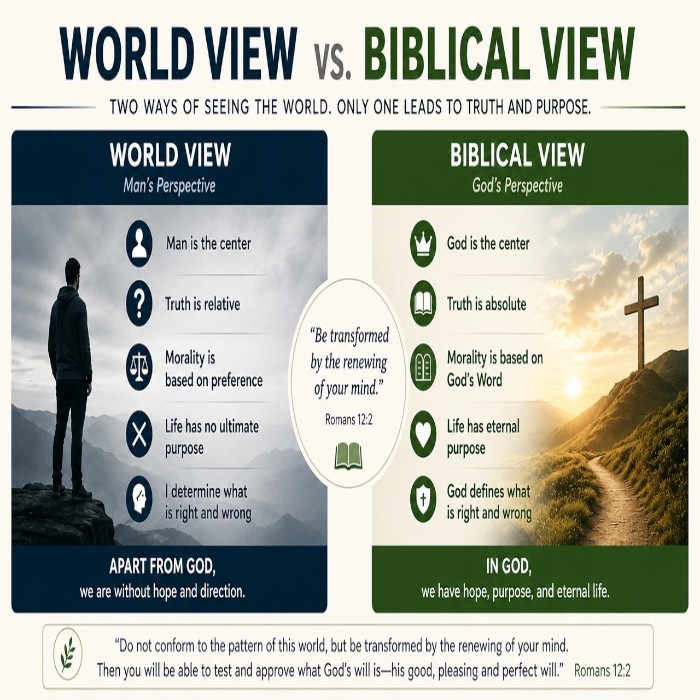
I think this is what Romans 12:1 2 is talking about.
So I'll just read that, especially verse two. I'll just read verse two, Romans 12:2. It says, do not be conformed to the world, but be transformed by the renewal of your mind.
That by testing you may discern what is the will of God, what is good and acceptable and perfect.
Don't be conformed to the world, but be transformed by renewing your mind. So be transformed by changing the way you think, changing the way you think about things. And I think especially that involves changing the way we think about sin. I think it involves changing the way we think about God's instructions to us.
If we see his instructions as warnings to keep us away from things that harm us and cause us damage, then I think we'll be understanding his instructions a lot better.
And I think that's what this verse is getting at.
So by changing the way we think about things, changing the way we think about his will, we will see that his will is good and acceptable and perfect. And when we see it that way, it makes it a whole lot easier to follow what he's saying, I think.
All right, that makes sense.
Yeah. I think if we change the way we view sin, it gives us the ability to overcome temptations a whole lot better.
So you mentioned the changes is something that happens inside. A couple people mentioned that.
So, I mean, God has called us to change and it's not a minor change. It's a radical change.
It's a change that's so significant that Jesus talks about it as being reborn.
You're a new person. It's obviously a metaphor. And I think Nicodemus kind of got lost in the metaphor in there, this reborn thing.
But Jesus point is, basically you're called to change in such a radical way that you're a new person, you're different than what you were.
And that involves water and spirit. And the way I read this, it's cleansing and renewal.
I think that's what he's speaking of here. Of course that happens in our baptism, but it's also an ongoing thing in our life that continues to happen. Right.
So we used a lot of different metaphors so far. We've talked about being reborn. We talked about being stuck in mud and some others. There's another one I thought about.
You ever watch the HGTV shows where they renovate the houses and they go in and completely clean it up and, and then turn it into a whole new house?
I love watching those things.
I love that they can do all that in just an hour.
I mean, it looks really fun, looks really easy and actually hope to one day when I retire, hopefully that may be my second career.
It looks like a lot of fun, but it's kind of the same thing. First you got a torn up house. It's, it's in horrible condition. The first thing you gotta do is clean it out and then you can rebuild it. Right. I think that's what Jesus is saying in this is I need to forgive you, I need to clean you out, I need to fix your past, but I'm also going to fix your future.
And I'm going to not only forgive you for what you've done, but I'm going to renew you and change you to change your future. I think that's what Jesus is after.
I say all that to say the class is on the Spirit. So I think that's the focus of the work on the Spirit.
The work of the Spirit is that transformation is that renewal and that change of us. And it's something that happens again, happens in our baptism.
We are renewed. We are a new person at that point. But it's also something that continues to happen over time.
Sanctification is a process that happens throughout our life.
So going back to this idea of the wind and spirit.
So we have this unseen power.
We have this unseen power in us.
We have an unseen power that's dwelling in us and it is accomplishing that transformation.
We can't see it. We can't see him directly, but we can see the results of his work. So what we're going to try to do this quarter is better understand this wind, this power that's in us.
And we're going to try to work through that. There's a lot. And luckily there's a lot of scripture to help us to try to work through that. Like I said, we won't touch all of it.
There's more topics than we can cover in the quarter.
But I did want to talk a little bit about the class format as we go through this.
So these are the main topics.
Like I mentioned earlier, I've been studying this a while. I read a lot of books, read a lot of articles.
Some of them are good, some of them not so good.
I even learned some Greek and some Hebrew words along the way.
I've been praying about this topic for a while.
But at the end of all that, I still feel like understanding the Spirit is a little like trying to understand the wind. And I think we can spend a lifetime on this subject.
And honestly, I hope that we do. I think this is something that we need to spend our lives studying. I mean, again, going back to what I said in the opening, this is understanding God. And I do think we need to try to spend a lifetime trying to understand him and know him, even when he's mysterious to us. Or maybe especially when he's mysterious to us.
The main approach for the class is to try to let God speak for himself.
So we're going to try to focus on understanding what the Scripture says about the Holy Spirit.
We may have a lot of questions about the Spirit, but we're not going to get to those until the end. More towards the end of the quarter, because I really want us to let the Scriptures guide us in our study.
So a lot of times I've noticed when I come with my set of questions, I sometimes miss what God's really trying to say because I'm trying to answer my question and I miss what it's really saying. So we're going to try to let the Scripture speak for itself.
But that said, I do want to try to save some time to answer some questions, and I would love for you to send me your questions, and that will give me some time to think about them and work through them.
And we'll try to do that towards the end of the quarter.
All right, so the main topics wanted to speak on that we want to hit. And these will kind of line up with the weeks, but not exactly but for the most part, those will kind of line up with the weeks. But I want to just kind of set some foundation.
First we need to understand that the Spirit is God and what even the idea of Spirit is. Then I want to do kind of a broad survey of throughout Scripture, what does it say that the Spirit does? Because there is a ton of scriptures that talk about the Spirit and we won't be able to hit all of them, but we'll just try to take as many as we can and talk about, here's what the Spirit does throughout Scripture.
Then we're going to deep dive into some specific topics.
One of these, and these are kind of themes that kind of recur that I've seen. One is the idea of the Spirit as a creator, but not only a creator, a recreator, a renewer or a refresher. So all those are kind of in the same vein. So we'll talk about that.
The next is the idea of the Spirit as God dwelling with us.
And that's a theme throughout Scripture. God dwelling with his people. And the Holy Spirit is in that line of history.
It's a major advancement in the line of God dwelling with his people. So we'll talk about that.
One of the big roles of the Spirit throughout Scripture is a teacher inspiring the writers of the Bible, inspiring the prophets and others. But bringing God's message to man is one of the big things we see throughout Scripture.
And then we'll see that. I got a typo. But we'll see the Spirit empowers.
Another big theme that we see throughout Scripture is the Spirit empowering people.
And then we'll work through Acts. There's so much in Acts.
I think the Holy spirit's referenced like 60 to 65 times, something like that in Acts. He's all throughout the book of Acts. So we'll hit as much as we can of that and then we'll kind of shift a little bit. Well, then we'll talk about gifts of the Spirit as well.
And that'll kind of focus on 1 Corinthians.
Then we'll shift a little bit into some of the misunderstandings that we see about the Spirit and we'll hit some of those and then we'll try to hit some questions. Questions and answers.
Alright, so next thing I want to hit is in Matthew chapter three and the way I want to work through the topics. So normally when you teach, I try to come up with a 40 to 45 minute lesson that kind of fits the time we have. And sometimes it's Kind of hard to make what you want to say fit that.
So basically what I'm going to do this time is I'm going to just kind of keep going and when the bell rings, we'll kind of pause and we'll pick up the next week and pick up the next topic. So those might not always line up exactly with the weeks, but that's kind of the idea.
Matthew 3, 13, 17.
This is the story of Jesus baptism.
It's one of the few stories in the gospels, one of the few stories that's in all four gospels.
There are a few things, but this is one of those events that's in all four gospels, his baptism.
So this is Matthew's account, Matthew, chapter three, verses 13 through 17.
And just so I can pause talking for a second, somebody wants to read that.
[00:27:42] Speaker C: Then Jesus arrived from Galilee at the Jordan, coming to John to be baptized by him.
But John tried to prevent him, saying, I had need to be baptized by you, and you come to me.
But Jesus answering said to him, permit it at this time, for in this way it is fitting for us to fulfill all righteousness.
After being baptized, Jesus came up immediately from the water, and behold, the heavens were opened and. And he saw the Spirit of God descending as a dove and his lightning on him. And behold, a voice came out of heaven and said, this is my beloved Son, in whom I am well pleased.
[00:28:23] Speaker B: All right, so there's.
We could spend a lot of time on this. But I really want to make three points from this passage.
The story of Jesus baptism, and the first.
The first point I would like to make is Jesus did not need baptism.
You hear John point that out and he was right. He didn't need it. But why was he baptized?
Yeah. So I think both of those answers are right and they're saying similar things in different words. So to fulfill all righteousness was Jesus quote from that he gave.
I interpret that to basically say, because it's the right thing to do.
I think that's the gist of what he was saying to John.
And why was it the right thing to do?
Because as a man, he was giving an example for what men needed to do.
[00:29:22] Speaker A: Right.
[00:29:24] Speaker B: So I think Jesus was doing this as an example for us. So if it's an example for us, you know, let's look at his baptism and what happens there in that. So that kind of leads us. So the first point is.
The first point I wanted to make just from observation of this is he didn't need baptism, but he did it as an example.
So what do we see then in that example? Well, one thing I see is that two things happened to Jesus and for Jesus in his baptism.
And these same two things happen to us and for us in our baptism.
The first thing that happened to them, and they aren't necessarily in the order that were presented, but the first thing I mention is that the Father declared that he was pleased with his Son.
So there's a voice from heaven that happens, and the Father declares that he is pleased.
Jesus was everything that God desired of man. He was a man, and he was the perfect man. He was what man was supposed to be.
And God is saying in this moment that he is pleased with him.
For those of us that had great fathers, I did not. Much more I wanted than for my Father to be pleased with me.
For him to say that or know that he was pleased with me.
I mean, there's not much I wanted in life more than that.
So for your Father to say that he's pleased with you is a big thing.
So this happened to Jesus. But I'd say this also happens to us in our baptism.
When we come out of the water, we are reborn. And I think in that moment, God is pleased with us.
We don't hear a voice from heaven like it happened with Jesus, but nonetheless, God is pleased with us in our baptism. So just as it happened to Jesus, I believe that happens to us.
The second thing that we see that happened to Jesus was a dove descended. A spirit in the form of a dove descended upon him or rests upon him.
The word in the Hebrew word for rest is Shekinah.
It also means to dwell, to rest or to dwell. And the Jews use that word as basically the dwelling presence of God. That's how they use that word, the shekinah.
So basically, the Spirit dwelled with Jesus or rested upon Jesus is the idea here.
And I kind of hit on a little bit earlier. But this is a very significant event in the course of history of how God works, is working his rescue plan for man and his desire to dwell with man.
We see that throughout history.
But this is a major event in the course of that history of God dwelling with him.
So the same thing that happened to Jesus happens to us again, not in a dramatic way like it did Jesus. There's not a literal dove that comes down, but nonetheless, the Holy Spirit does dwell with us following our baptism.
So these two things that happened to Jesus also happened to us. And we'll say a lot more about these things as we move forward.
[00:32:59] Speaker C: Is that the same word that's used in the Old Testament, the Jews died, actually grew, dwelt in the temple.
[00:33:07] Speaker B: Yes.
[00:33:08] Speaker C: And one of the prophets saw a vision of God leaving the temple. Is that the same word?
[00:33:14] Speaker B: It is, yes. Yeah. Ezekiel.
Yes.
[00:33:19] Speaker C: So God left the temple because of their sin, but God comes and dwells with Jesus and with us in the very same way, I guess.
[00:33:31] Speaker B: Yes.
Yeah. And we will hit on that whole thread in a few classes. Three or four classes from now, we're going to hit on that whole thread. We're going to dive deep into that. But absolutely, it's the same word.
It's the same idea.
And this is an event in that line of thinking, in that line of history. Yes.
The third point I wanted to make about the baptism of Jesus is here in this moment, we see all three persons of what we call the Trinity.
Of course, the word Trinity is not in Scripture, but the idea is we see the one God in three persons, and we'll try to get our head around that.
I'm not sure I can.
I'm not sure I will have words to say that will make it all clear to you. Okay.
But it's something I know to be true, even though I don't fully understand it.
But anyway, we have the one God, but we have that one God and three persons. And so at Jesus baptism, we see this.
We see God the Son, obviously, in the person of Jesus, the one being baptized. We see God the Father and the voice that comes from heaven.
And we see God the Spirit in the form of a dove, descending and resting upon Jesus.
There's some other places in scripture where we kind of see all three, but this is one of the big ones where we see all three of those.
In this case, we see all three in action.
All right, so the next thing I wanted to hit on is the Shema. And this is probably about as far as we'll get.
So the Shema is a Hebrew prayer.
This was central to every Jew's life. They would say this prayer daily. They would say this prayer twice a day.
They all knew it, they all could quote it.
And again, this was central to their faith.
And in English, it's, hear, O Israel, the Lord our God, the Lord is one.
You shall love the Lord your God with all your heart, with all your soul, and with all your might.
And there's so much in this.
I wish I could spend 20, 30 minutes on it.
There's so much in this, but to go through a few of those words.
We'll start with the second half of it, and then we'll Come back to the first half of says we're supposed to love God with all of our heart.
The Hebrew word for that is lebab.
So in Hebrew, they actually didn't have a word for brain. They didn't really understand what a brain did. They didn't understand the function of a brain.
So to the Jews, your thoughts, your mind, your emotions, all those things came from your heart. So when the Jews talk about your heart in Hebrew, when they talk about your heart, they're talking about your inner person, your thoughts, your desires, your emotions, all those things that we think of as our inner person.
So the first thing is we're supposed to love God with all of our inner person.
The second thing we're supposed to love God with is all of our nephesh.
That's another kind of interesting word.
We normally translate it as soul in English.
The Hebrew understanding of this word is a little different than most people's English understanding of this word.
But really, what nephesh means is it's a living being.
It's your whole self.
A good translation would really be self.
So we start by loving God with our inner person, our heart. And then we start.
And then next we love God with our whole person, our whole self, our nephesh. And then this third word is meod, which is a really strange word. It's actually an adverb, and it means very or much.
It's not a noun. It doesn't really fit the syntax. Right. So we love God with our very.
So the idea here is that which overflows.
So we love God with our inner person, our whole person. And then everything that flows out of us, they translate it normally, heart and soul and strength or might. And that's as good as any. But the idea, I think is we love God with everything we have, every bit of us. And that's really the idea of what they're trying to say here.
All right, so I don't want to hit on the first part of this is, hear, O Israel, the Lord our God, the Lord is one.
So the idea of God being one was absolutely central to the Jewish belief system.
And so any understanding of the Holy Spirit needs to understand that God is one.
Even though we have a fuller understanding of that and we think of God as three persons, we must not also forget that God is one. That hasn't changed.
So as we try to get our head around that thinking of God being one, yet God being three persons, again, I don't know that I have words that's just going to make it click.
But nonetheless, we know that it's true. So as we study the Holy Spirit, the point really I want to get to is we need to also remember that God is one God.
And as we look at him now in three persons and see that, don't forget that.
Alright, so that's a great place to stop. So we'll pick up there next week.
Anyway, guys, thank you for being here and looking forward to continuing this study with you.