[00:00:00] Speaker A: Hey, thanks so much for listening to this message. My name is Jason and I'm one of the ministers here at the Madison Church of Christ. It's our hope and prayer that the teaching you hear today will bless your life and draw you closer to God. If you're ever in the Madison area, we'd love for you to stop by and study the Bible with us on Sundays at 5pm or Wednesdays at 7pm if you have questions about the Bible or want to know more about the Madison Church, you can find us
[email protected] be sure to subscribe to this podcast as well as our Sermons podcast, Madison Church of Christ Sermons. Thanks again for stopping by. I hope this study is a blessing to you.
[00:00:37] Speaker B: I hope you've enjoyed our study so far. We finished up Chapter four finally last week. Only took us nine weeks, but believe it or not, I have a syllabus for this and this is exactly where I want it to be.
Because Exploring Esther the first four chapters are very heavy. I wanted us to really take time to get context just so that now we reach a resolution phase. Chapters five through ten kind of pair up pretty easily. So tonight five's got a little more content to it, but we're going to do chapter five tonight, maybe a little bit of six, but over the next couple of weeks we only have four classes left, counting tonight, but each of those we're going to kind of pair up some chapters because now we've sort of been setting up the dominoes in the house of cards and about to come tumbling down all these plans that God has been setting up very minutely. But I'll read a couple things before we get into Esther 5.
A couple things. I want to remind us about our histories because I want us to think about what Esther knows at this point about history.
Back to our friend Herodotus, Xenophon, those great historians, Herodotus tells us as a reminder among the Persians, benefactors are greatly honored in return in proportion to their magnitude. Got to remember that Esther knows this. She understands how gift giving works. It's all about transactions.
Not in the same way that the relationship with God is the king ensured that his rewarding of individuals with vastly extravagant gifts. He was creating a relationship so unbalanced that there was no conceivable way of leveling accounts and no conceivable way of terminating the relationship, unless by the king's own doing.
However, the relationship was usually mutually beneficial and it was in neither party's interest that to sever that tie. That's another thing she knew about gifts, Xerxes would always outdo you to make sure you couldn't outdo him. It wasn't about that, no matter how pretty she was.
Within the empire, the king was naturally the dominant partner in gift relationships and was fully aware that the really important aspect of exchange was not economic but one of status, and his status was absolute.
In such cases, the generosity usually associated with gift giving is largely ritualistic gestures of subordination.
Symbolically, the correlation between imperial status and gifting is reflected by the Persian demands for earth and water from conquered nations. Give me earth and water. Submitting your land and resources. The call was symbolic, representing surrendering of provincial resources to the king and an acknowledgement of his subordinate status over you and everything you own. It was in the royal interest to create relationships of dependence.
The king benefited through legitimization and reinforcement of his superiority with the granting of a gift so magnanimous, the receipt was in constant the recipient was in constant indebtedness and I'll shift gears here as Joel Wilder he had shared an article with me this week he saw with a from it just kind of popped up this week. It was from the NIV Study Bible about a couple of points that I thought were interesting that I hadn't thought of, and a couple that I thought were interesting about Esther and some of the reasons a lot of people don't understand Esther. Martin Luther, the great Reformation guy, hated Esther. He didn't understand what to do with it. He fought against its inclusion, actually, because again, it didn't mention God in a way that he thought.
There were a lot of translation errors at the time. They weren't quite sure what to do with it.
But there are some interesting points here that I think chapter four and five reflect.
As we think about some comments from this article I want to share. Esther was part of a group that stayed in Persia, the Jews. And we have to realize that they were Jews that stayed in Persia even after they were allowed to go home.
Jews back in Judea accused them of being soft traders, getting too comfortable in captivity and forgetting where they truly were from.
Some may have felt compelled to stay for practical reasons. It's hard to understand why, but they were there.
Questions are raised about whether Esther should have even been in the beauty contest she was. Why did she even submit to this if she was godly, if it was inherently immoral and she had to conceal being Jewish, how was this right? A Jewish refugee girl in the 5th century didn't have much agency. Then again, Joseph, a slave in potiphar's house in Egypt didn't have much choice when Potiphar's wife commanded him to sleep with her and Joseph went to prison for it. Should Esther have done the same? I don't know. It's not hers to ask. Is the point of the article. God is working in both of those stories.
And I mention this because throughout all this, we don't have to go into all of it, but it's an article called right where you're supposed to be the NIV study Bible. But one of the points made in here is about the idea of a theology of place.
The idea with Esther, the concept of place. And this is something Esther gets okay, and this is why she's successful. Something the Jews didn't understand until now, the idea that her relationship with God is independent of the temple. Right. It's not about the temple. It never was really about the Promised Land. It was all leading toward Christ.
Bigger things.
She had to be able to see God, where she was.
I want to put this verse up here now. Deuteronomy 31:8.
Just read that to yourselves for a moment.
Kind of read that. That verse is one, you know, it's part of the Torah, the Tanakh. They would have had this, you know, Esther would have had this scripture. At least we know from Mordecai's teaching. She understood basic Jewish wisdom literature as well as the Torah. This verse, the Lord goeth himself, goes before you and will be with you, and will never leave you nor forsake you. Do not be afraid. Do not be discouraged. You can imagine Esther having to recall that and lean on that.
And in Acts 17, this is something this article mentions about a theology of place.
And in Acts 17, verse 24, I'm going to pop over there. Acts 17:20, I want to read this. I know this is in the New Testament, but in verse 24, this is Paul when he's in front of the areopagus. In Acts 17:24 to 27, says God, who made the world and everything in it, since he is Lord of heaven and earth, does not dwell in temples made with hands, nor is he worshipped with men's hands as though he needed anything, since he gives to all life, breath and all things. And he has made from one blood every nation of men to dwell on all the face of the earth, and has determined their pre appointed times and the boundaries of their dwellings, so that they should seek the Lord, in the hope that they might grope for him and find him, though he is not far from each one of Us, for in him we live and move and have our being. The idea of borders, right? God is moving providentially. The countries, the satraps of Persia, everything is exactly where it needs to be. Esther is where she needs to be. We face that today thinking about, well, why is this happening to me?
Why am I here? And that's a lesson that Esther's going to learn.
And I want us to think about paraphrasing what Esther 5 is all about.
Esther, at the end of chapter 4 is told by Mordecai for such a time as this, right? This is the famous verse, Esther, you've got to act.
We see Esther calmly think about it. And this is what I think of, you know, Esther has two choices. To question that and say, well, am I here for a reason?
When in reality I am here for a reason, right? You have to know it. And that's what Mordecai is telling her. Yours is not to ask, right? And ours is not to ask. Today, it doesn't matter.
It's not, am I here for a reason? What's my purpose? What is the purpose? There is a purpose, right? Esther sees that and all she knows is, I'm here. God has put me here, and I have to choose. Okay, and now it's going to come back to something we talked about a few weeks ago. We really start to see the chiastic structure of Esther take place. I mentioned that a few weeks ago. Chiasm, it's a literary device of these dualities. Hebrew poetry is all about pairs. If you read the Old Testament closely, Psalms, even, a lot of repetition, it's on purpose. It's the way they express meaning. And just to kind of, you know, as we go through, we're getting. Notice how it's sort of a mirror effect, right? We see, I point this out because God is. He's showing us that this isn't just a story that has a point, A to B ending, right? He is showing us that he rebukes and has an answer for every action that Xerxes and Haman takes, right? Very thoroughly.
At this point in the story, we have in chapter three, where Haman receives the signet ring. Well, looking ahead, we're going to see Mordecai is going to get the ring in the end, Haman summons the king scribes to put the decree of genocide for the Jews. We're going to see Mordecai do the same thing later to take Haman out to defend themselves. Letters are written. Letters are written. The Jews, everyone is to be killed. By Haman's order, the Jews will defend themselves right back and forth. So I want you to think about that, because where we're at in the story here, we left off with Susa being the city of Susa, being bewildered, anxious.
What's happening to the Jews? Are we next?
But we see toward the end, the Susa will rejoice when Esther and Mordecai are in control.
And so that structure is going to continue.
So we left off just kind of a quick review at the end of chapter four in those verses. And I want us to remember the anxiety here that Esther probably faces. And I maybe said this wrong last time too. Let's remember. It's not Mordecai talking to Esther, right? He's having to speak through the eunuch Hegai.
She can't even see him. He's at the king's gate because he's in mourning. They go back and forth. And then Esther gets it. He's trying to show her it's go Tom. Esther, it's time to be Jewish. Who are you? Are you Hadassah?
Are you Esther?
She's the only character in the story that has two names. You notice that again, that chiasm. This is a point God saying, it's time to choose. Are you the Persian queen or are you my queen?
That's going to work for me.
We know that at this point we start chapter five, we again have a chance for Esther to. And Mordecai saying, we know where our family's been from. We know how our ancestors failed in Saul with the tribe of Benjamin and Esther, this is your time.
Romans 12. Jumping ahead into the New Testament, we see about the idea of what true worship is, being a living sacrifice.
This has not happened yet, right in the scripture, but Esther's seeing that now.
I'm going to have to sacrifice myself. I'm going to die or I'm going to achieve it. But I have to act, and I won't go over these again. But just as a reminder what Esther's walking into, I've tried my best to paint a picture, and I hope I have. Xerxes is finicky at best. He's emotional.
He reacts quickly to things. He does not like being insulted. He's very jealous of everything and everyone. He's paranoid. He did extremely dangerous things. That's on historical record even at this time. The scourging of the Hellespont during the Greek invasion, where he had his men actually whip the ocean because the storm came and he was petty and strange.
All the people that he betrayed because they broke protocol, he had them killed. So Esther knows through the histories, we even have evidence of Xerxes being very unstable, even for a Persian king.
So now Esther is faced with a question. Are you gods or are you Xerxes?
And now is when, again, as I mentioned, she has to pick who she is and whom she belongs to, right? Isaiah 43:1.
Another verse she would have been familiar with just quickly, that 1.
Isaiah 43:1. But now, thus says the Lord, who created you, O Jacob, who formed you, O Israel, fear not, for I have redeemed you, I have called you by name.
You are mine.
Esther has to believe this now, right? She either does or she doesn't. There's no in between. It's her life or her people's lives.
And Mordecai is pleading with her to be an example. And just a couple of verses we looked at last week. Verses like Jeremiah, Joel, Ezekiel. These are chapters and books in the Bible of telling the people, you're going to go through exile and trouble without the temple. You've got to find your way back to God. You've got to break through as children. You've got to grow up. The Jews were immature spiritually. They needed to find their way to God, and they had lost their way. It wasn't God.
Stand at the crossroads. Ask for the ancient paths. You will find rest.
Esther is at a crossroads. We're always in a crossroads. That's the whole point of those books. Let's remember, God's saying there's never a. You're either. What is it? You're either in a storm, coming out of one, or about to go into another one. That's life. And he's telling. That's what Esther's having to learn here. You've got to dwell on me. And I think one question I can imagine if we were to paraphrase so far what Mordecai has told her.
Esther, you have one question to answer. Do you believe in what God has said or not? It's that simple. There's no in between. You either believe he's going to save us or not. And, you know, looking ahead to the New Testament, we have examples of this, how to live a godly life.
For if you keep silent this time, Mordecai is pleading with Esther, saying that if you're silent, this is going to be a problem for you. God is going to redeem our people.
But you have a chance to do it, okay? You have a chance to be a part of that. Story.
You have to be a light on the hill, we would say in the New Testament, you have to. That's not an option.
I like Philippians. Two children of God in a warped and crooked generation shine among them like stars in the sky.
It is funny, the Hebrew word for the star is astar ashtar.
But I do think that's where we live today, right? Warped and crooked generation.
But they did as well. But the point of this is that Esther realizes now she has to be not just a queen, but she has to be an example for her people. That's what this is about.
So she decides to move in verse 16.
And I love that we don't see Esther break down. She does break down later in front of Xerxes. She has a moment of weeping. Who could blame her? But to this point, she says, okay, I love that. You know, she gets right to it. And she says, all right, go and tell all the Jews to fast for three days.
I'm going to do it, too.
If I perish, I perish. And notice this. This is important.
She says, I will go to the king aware it is illegal. She knows it's illegal. They don't have excuses. She says in chapter four, every man and woman in the kingdom knows it's illegal. Okay? So no excuses.
So in Esther 5, as we kind of go through this, we're going to see Esther choose bravery.
We're going to talk about her banquets and the reasons why she did two banquets.
And look how Haman's pride once again gets in the way. Poor Haman. I mean, don't feel bad for Haman, but Haman. In the article I was reading earlier, from Now Is yous Time, the author referred to Haman as the Dwight Schrute of Persia. If you've ever seen the office, I think that's pretty funny. Assistant to the regional manager. That's what Haman was. He had no power except for what Xerxes gave him. So I can't get that image out of my head.
But he really was. He was an odd guy.
And Haman is going to execute his plot here.
So Esther 5, verses 1 to 3, as we see Esther actually approach the king. If you'll read with me, Esther 5. Let's look at the first three verses.
Okay, so Mordecai has gone away.
He's told the people and Esther that it's go time.
She fasts for three days.
This is where Purim's going to come from later, right? They're going to preserve this Purim on the Third day, Esther put on her royal robes, that's important. And stood in the inner court of the king's palace in front of the king's quarters while the king was sitting on his royal throne inside the throne room opposite the entrance to the palace. And when the king saw Queen Esther standing in the court, she won his favor in his sight.
And he held out to Esther the golden scepter that was in his hand. Then Esther approached and touched the tip of the scepter. And the king said to her, what is it, Queen Esther?
What is your request?
It shall be given you even to the half of my kingdom. Now, some other translations of Esther in the Hebrew tradition. Add some context, and you'll see this. And I don't want to cause a controversy. There were other translations of Esther from something called the Targum, if you want to look that up. T A R G U M. It was an early translation of Hebrew to Aramaic. Aramaic was the state language of Persia through this time. Okay, they. It's not a different version, but they add more words. They flesh out the words that are there and then add the meaning, saying, well, this is what it means.
And so in Hebrew, they're in Aramaic as well.
There are some other words and some translations you may see. It adds a little context and says the king sort of gets angry for a minute. Esther falters a little, walks up. It doesn't change the meaning. Okay, the scene's the same, but what we need to understand is Xerxes does relent here, and he extends the scepter. Now, why is it a big deal? The first two verses, and we've talked about this a little, but you notice it goes into detail about she was here, then she went in the inner court, and he was facing there, and he was sitting there. That's telling us something very important, because when Esther comes in the inner court, you have two options. It's mercy or death.
Mercy because you dared to come before the king at all. And even if you came to the king with protocol, there was a ceremonial, okay, you're here. I'll allow it. But if you break protocol, we've explained each week, doesn't matter if you're family, you're dead. The axeman was right there.
And Xerxes has to choose now, mercy or death, what does he do to his queen?
And it tells us this. And it's important because here's another kind of a. I had the other diagram of the palace up, which is the Google satellite. This is sort of a drawing of it to Sketch it. And I want us to remember this is sort of the palace. You've got the king's gate. And outside of Susa, I'll remind you, this is important for chapter eight and nine. There's a whole citadel around it of a wall. It's not just this whole thing is the palace complex. Outside of that is a city complex. And outside of that is where the serfs live. Right? The peasants, the artisans. Okay? But inside the palace, through the king's gate, where Mordecai would be, you know, we've got the harem down here. This is where it would be in the palace, based on archaeological evidence.
And the inner court, See, this is the throne room. See that blue mark? Now, Xerxes had access to the harem for reasons. Right? He would often get away when he wanted to be with his women. Okay? He had quick access to just go as he pleased. But don't come to him without being called. Right? You don't do that. But that's not how this works. If Esther had come through here, I mean, honestly, she probably would have been killed. I don't know. Now I'm going to say God, his providence is at work. We don't know. What we know is what we know. But Esther is smart and she knows there's only one way to do this. Protocol.
So over here is what's called the western gate. And the women's court, I don't have it yet. This is where Vashti would have held her court in chapter one.
So we have Esther and we have. She would have either had to go out and probably either gone through the gardens or she would have exited the palace. There were other ways to go here. The harem women could go with the eunuchs here, but they could not be seen by other men unless Xerxes allowed them to be. So not only is she endangering herself, but every other man that sees her, she does not go covered. She approaches him in her robes and as a royal courtier.
Okay, so she's breaching some protocol, as is. There's a military court here and an outer court. This whole thing here is the outer court, where soldiers would meet the apadonna. At the top is where they had the massive party in chapter one.
But we will see. Esther is going to come through here, probably raise some eyebrows, march through the outer court.
By going through the second and inner court, she's making a statement.
I'm here on business. Right. This is weird. They wouldn't know how to react. Right? This is the queen and nobody wants to say they looked at her because they're going to die, right? Esther's dead here. If she doesn't pull this off, there's no trial. If she doesn't pull this off, she's going to die.
She marches through the courts, all that fanfare I've been showing you the last few weeks, and gets to the inner court.
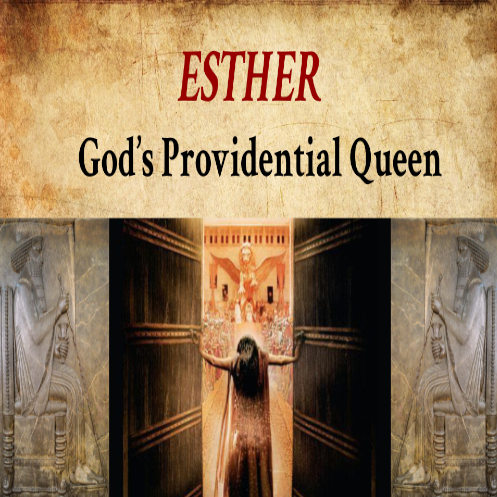
And this is where she kicks the doors open. Because once you're in the inner court, Xerxes is having court here, facing the inner court, so he can catch anybody who tried to assassinate him. And that's how they catch him. And so Esther is going to throw the doors open. And it doesn't say there are other people there. But based on the subject matter here, there's no way he was alone. He's holding court. Okay, it doesn't matter.
But other people saw this.
Now, there's a few reasons I think we need to look at here. Now, Esther is partly in protocol, right? She does go with the royal robes. It says we know. And I won't waste time looking at other sources. I got plenty. But we have a lot of historical confirmation of what that meant. There were certain bluish robes they would put on over white. They were inlaid with certain things and all these elaborate gems and jewelry.
And so she has the right robes on, but she wasn't called right. So X right there. She's dead probably. Unless he gives mercy.
We only have very little to go on. Based on the women. Again, there just aren't a lot of artifacts about what they wore. We've got very, very vague cuttings and carvings that kind of show us kind of what the women wore.
Almost always with a shawl around their head with a crown. If they were royal body is covered, much like the men, but pleated. They definitely had pleated robes. See that? That's probably what something that's probably close to what Esther wore.
These long tunics over long pleated robes, as we see here, with a crown and jewelry. That's probably pretty close. And she also would have been wearing the colors that were important.
This is a Tyrian snail or Tyrian mollusk. I don't know if you've ever seen those or maybe if you've researched anything about Phoenicia. This snail is what drove kingly commerce from Persia to Rome all the way through the time of Christ.
And so I show you that because it mentions colors here in the next few chapters. This was mainly found in the Phoenician land of Tyre. Thus the Tyrian snail, if you Remember that from kings. That's where Jezebel was from. This is now a satrap of Persia. And this is the rare snail that gave them the special color purple that was used by the Romans in later time as well as well as the Persians. And you'll notice it was various shades of purple and also blue.
They would get, depending on the age of the snail and how much they dried it, they would use that to do it. And it took, history tells us, somewhere around 12,000 of these things just to get one gram of pigment. So they would harvest these things and only the rich would have it. And also the red. You see, in later periods, a few hundred years later in the Roman Empire, when the senators wore the white robes with the red trim, that's where they got it from. Because it also would make a burgundy color and a blue. And depending on your rank, you got to wear it. Esther would have been wearing purple. If it says royal robe, that's what it means. That's not a buzzword. She would have shown up with her purple, which means, I'm here on business. I'm here as the queen and I'm making a demand. The problem is Esther does not have clout. She is not the queen regnant. We talked about that. She does not have power outside of being Xerxes wife. She's not even the mother of his children.
So in Persian lore, right, she's just the best concubine.
Let's be honest. He likes her. But that may end.
So I show you that.
And this is a little small, I know, but a couple of quick points I want to make. We do have evidence. People have done research on kind of what the colors mean. And in Persian coin, it's a little small, but royalty would wear silks and fine wool. So the Bible language is constant with what we see. These are all academic sources.
Purple and crimson were allowed, as well as gold threads and gemstones. This means that if you were wearing the wrong kind of jewelry, sorry, if you liked gold, but you can't wear silver, too bad you can't wear it. If you were caught wearing it in the court, dead high nobility would wear wool and linen. They would wear rich blues.
Pay attention for that later with Mordecai, he's going to be robed in the blue robes later on purpose. Those little tidbits is what make the story work, because that helps us date it until it's real. Whereas as you went down, the lower nobility and commoners would wear sort of none natural dyes, earth tones, see? So Again, protocol, it really mattered. And some of the jewelry, which some of this is in the British Museum, other museums. This is one of my favorites. I love this image. The only royalty were allowed to wear these gold bracelets with the mythological creatures on top. Sometimes lions, sometimes other things.
But if you showed up wearing that, your own business. You're saying I'm a royal and I'm your equal. Now Esther would have worn these things probably to him to show up in court. I imagine she probably had this on other jewelry we do have evidence of in history. Beautiful, isn't it? You know, the kind of things they would wear.
But I want to ask a question here before we continue. It says that Xerxes sees Esther, okay. And he extends the scepter and it was called the scepter of Mercy.
What is the difference between mercy and grace? And I'll ask anybody who wants to say, what is the difference between mercy and grace?
Right. Grace is a gift you don't deserve. Mercy is withholding punishment you should get based on the law. Right. That's what's happening here. Okay, he's not being gracious, but that was a rule. The only way to allow her in a breach of protocol was to extend the golden scepter.
And we do have. Whoops. Kind of hung up there a minute. It'll catch up. But we do have evidence of these in history. One of the few golden scepters that were unearthed in the city of Persepolis.
I can't remember if this was Susa or Persepolis. I think it's Persepolis. I forgot my citation. But this is one that was found buried. And this is a golden scepter from the 5th century Accumulated Empire period, which is Persia.
And it was buried underneath the cornerstones of foundation in the palace. See the gold with the lapis lazuli.
This was a broken scepter. And what they would do, that's how they found the Cyrus cylinder. All the things we do have, they would bury them beneath the foundations as sort of like a time, not a time capsule, but like a blessing. And so they would take a scepter and that would be buried too, granting it the blessing of royalty. Right. Most of the artifacts that were above ground were looted right. By Alexander the Great and just looters. So a lot of that stuff we don't have because it's made of gold or the stuff we do have came out through various conquerings of countries.
But you know, it would have looked something like this with probably a longer tip to it.
But again, Extending the scepter was there as an act of mercy. Esther, you've broken protocol.
Death is what you deserve.
It's the law.
But Esther goes forward anyway. Right? We see. And you can imagine she would have strolled right up to him to get the scepter. That means she walked right up to him. And you can imagine the eunuchs and everyone who was there had the weapon ready because that was protocol. Looking at Xerxes, give the scepter or death. It's kind of like the Roman gladiator thing, right? That's it. It's that simple. This isn't a jury trial. Right?
Doesn't matter how pretty she is or how much he likes her. They're looking to him. Haman's in the court.
He's going to be.
And so we see that. We do have history sources that tell us he could do this. Now, a couple things I want to point out. Again, I just want to throw out some things.
Number one, why did this happen? Okay. Number one, I want to be clear. The first answer obviously is God's providence. Okay. I don't want to get away from that. It happened because God said it would. Right?
Is this an example of Pharaoh having his heart hardened?
That's a debate we get in. What does that mean?
I have my own theories on that. But that idea of. Is God supernaturally turning the heart? I don't think so.
Maybe there's a lot of things there. But is that what's happening there?
We see King Xerxes. Is he reaching in and saying, I want him to? I'm going to make sure? I don't think so, because I don't think that's fair to God. We put God in a box. If God can't win by human rules, then what kind of God is he? If God is just hoping Xerxes does it, I'm going to have to magic his little heart? I don't think that's the God we serve. God has been playing four dimensional chess here. Since Saul didn't kill Agag. Let's remember that that gun was fired a long time ago. That bullet's not going back in the chamber. And this isn't a question of it. It's a question of when. Esther, will you be the one to do it? And if not, it doesn't matter because I'm taking this empire down. Right.
But Esther has a chance not to. Plenty of evidence in God's providence. And we won't read all those, but these are evidences I found.
You know, they knew what Isaiah said, I have purposed, I will do it. The plans of the Lord stand forever. It will come. And we see in Esther. We do see Esther playing on the heart of Xerxes. Xerxes did love her at one point, remember at the end of chapter four, she says, he hasn't called me in a month to his bedchamber.
What am I going to do?
That was it. That's all I'm here for. Frankly.
That's Esther's role. She's. What do I do? Mordecai says you're going to have to be more. She is so much more. But we know. But I will say there's a couple things I will submit to you, okay?
And I think there's some things that history helps us out. And this comes back to a theology of place at the right time, right? God has everything, everything, okay?
Exactly where they need to be, when they need to be to the second. And I fully believe that.
I fully do.
Because he knows where Xerxes heart is right now. There's some historical clues and I think this makes a lot of sense because again, history backs it up.
What's going on? These are some of my notes plus historical thoughts. But I think it maps. So if we look at the date this is happening, this would be happening in 474 B.C. based on all the stuff we've talked about each year, 12th year and all that, Esther has been five years a queen.
Okay, it's 474 BC early. Okay, what could be happening to make maybe Xerxes chill out a little bit and show some mercy? Well, we do know some things.
Couple of things we have to remember. He's really still reeling from a Greek defeat back five years ago when the war was ended. And we won't show the graphic again, but remember the empire was as big as it would ever be under his father. It never grew again.
It only shrunk. And the Greeks didn't stop. They mocked Xerxes and their poetry, they mocked him and their arts. And what was Xerxes going to do? He just retreated back.
He was beaten and humiliated and the coffers were running dry. The Persians were getting antsy. We don't need Bible for this. We can just read history and the Bible is just knocking it out of the park for us. Okay.
The sources we have from history say that Persian rumblings were already happening. This may sound familiar to modern day. What happens when a politician does something? They posture and they say, I'm going to do this and I'm going to do this and we're going to blah, blah, blah. And then you don't deliver. Right. People get antsy and in an empire you really get nervous when everybody's trying to assassinate you all the time. History says under Xerxes was at its peak of assassination attempts in the Persian Empire. He was so paranoid when. That's why Mordecai had a job. They were literally trying to kill all his rivals off before they assassinated him.
So we see his failed wars. History says he had spent, even for a Persian king, opulently to the point where the coffers were running dry. Okay, money talks, right? You can't pay your nobles, you're in trouble.
A lot of posturing. And in nine years he will die. History tells us he has nine more years to live. He doesn't know that. But in nine years he will be humiliated and assassinated in bed by a eunuch and a guy named Artabanus, an advisor.
Okay, And I'll come back to him in a second.
But another thing that was going on, and I submit to you also to think about, is at this point again to posture. Xerxes is doing the thing all rulers do when they go out and fail.
All you got left is inward. Right? History tells us he was coming back home, strengthening the homeland, saying, hey, we're just going to. Let's just govern what we have. Don't worry about expanding. I'll make your lives better.
He was a warmonger, even for a Persian. And the people, his advisors, from Xenophon to Cesius, or historical sources we have that tell us. His advisors were telling him, you've got to calm down.
You've got to show the people you're strong but not a monster.
You've got to show them you can be merciful and rational and stop killing people just because they don't have their clothes on. Right, right. Even in Persian prodigal. This is kind of funny in a way, it's a dark comedy. But they're telling him, you've got to calm down. The people are tired of this.
And I think that's happening now. Another thing that happened this time, which I think is interesting, and I think this is God working too, at this time.
A few months before this, in 475, his mother had just died a woman named Atossa, who people actually liked. Okay, the Persians liked her. And actually one of the first Greek poems called Aeschylus about Persia, they wrote an epic about how they changed the names. It was clearly about the people praying and hoping that Xerxes would die and his mother would just reign. And he didn't like that. But he was grieving. Atossa is one of the few people that history tells us actually maybe loved him as a son. Xerxes was aware what kind of monster he was.
He was grieving, which I think Esther is going to use.
And another thing that happened, and this is documented is the eruption of Mount Etna. Has anybody ever heard you don't just have Mount Etna. So it's still a very active volcano out far to the west, really way out west. The problem is they're very superstitious.
Mount Etna had erupted at this time, killed a lot of people.
And at the time, what was happening was the grumblings were amongst all the empires at the time was this was the God's way of saying tyrants if you're ruling in an evil way. Because the people who were wiped out wound up being a tyrannical invasion force. And the Greeks said, this is what's going to happen to you, Xerxes.
Xerxes was getting nervous.
He did his magi, which I think is funny. I think they're turning on him. We're telling him, Xerxes, that's the gods, right?
That's Earth itself telling you this is an omen. If you don't stop and cool it a little bit, you're going to die right now. I'm just saying those are all things we can document where his head was. He definitely was in a state where he was rethinking how to be. And just a quick excerpt. There was a.
At this time the Greeks wrote a poem called Prometheus Unbound by Aeschylus that came out at this time on purpose to scare Xerxes. They circulated it and wrote it. It wasn't just to him, but it came out and went to him in a brief bit. And I want you because the way they worded it, they said, I saw and pitied a terrific shape, a hundred headed monster. When he fell, resistless Typhon, who withstood the gods with fearsome hiss of beak mouth horrible while lightning from his eyes with gorgon glare flashed for the ravage of the realm of Zeus. But on him came the bolt that never sleeps, Crashing down thunder with fire shattering him and his towering hopes dashed into ruin, smitten through the breast, his strength a smoking cinder. Lightning charred a heap helpless sprawling hulk stretched out beside the narrow seas pounded and crushed deep under Aetna's roots. That was a threat. They were using a myth they had claiming that Xerxes was this usurper of the gods in their myth. Typhon was a Gorgon, sort of monster that was overthrowing the gods. And the Greeks saw that as overthrowing natural order. This is what happens to you, Xerxes. You're going to be buried under there. That's the mountain, right? Xerxes was afraid of this.
Okay? So at this time, we do see him trying to make a few changes. So when Esther shows up, it's the right time maybe, right?
So looking ahead, we see the request given in chapter three. What is your request? He says, up to half the kingdom, and it will be given to you.
A couple of quick notes about this.
We know that the Persians had a law of reciprocity.
So when you extend the merciful scepter, you now have to give a gift. And I will say the whole half of my kingdom is kind of a metaphor. They would say that, meaning, I'm going to give you a lot.
There was a guy who actually took him up on that in history, and he had him executed because he was like, you're being lippy. Okay. You know, he didn't really mean everything.
But we do have examples of him giving gifts that got him into trouble. There's a story of him when he was on his military campaign way out in the west, at Susa, again away from home, where he got jealous, took the daughter of his best friend's of his best friend, had an affair with her, and promised her the same thing. I'll give you anything you want. And she asked for a robe he had, and it was a robe his wife Amestris gave him Vashti. And he gave it to her, knowing it would be trouble. And when they got back home, Vashti saw it in the hiss in the history and had her killed. Okay, so he didn't care. He had a good time. Right? He's not here for a long time. He's here for a good time. That is Xerxes, and that's who he's dealing with.
So when she walks in and we see the next four verses, four to eight, these are sort of some things that happen. Let's see if we can make a little headway there. Verse 4.
So she says, if it pleases the king, let the king and Haman come to a feast that I have prepared for the king.
Then the king said, bring Haman quickly so we may do as Esther is asked.
So the king and Haman came to the feast that Esther had prepared. And as they were drinking wine after the feast, the king said to Esther, what is your wish? It shall be granted to you. And what is your request? Even up to half my kingdom, it shall be fulfilled. Then Esther answered my wish.
And my request is, if I have found favor in the sight of the king and if it please you, the king, to grant my wish and fulfill my request, let the king and Haman come to the feast that I will prepare for them. And tomorrow I will do as the king has said. Okay? So in those verses, notice that Haman is called by the king, number one. So Haman's in protocol. She's not in the room.
The queen has made a formal request and she has two banquets. And to summarize, the first one she's going to throw. And this shows us she knows protocol. If you remember, I told you all about week one or two, dining protocol was you had to eat and drink and then have another banquet. Eat and drink, and you make decisions. If you still had the same idea that you had when you were drunk as you did when you were sober, vice versa, they would do it right. That's how they pass laws. Not a great system.
Esther knew that. She also knew he was grieving from the loss of his mother.
She also knew the way to his heart.
But it was a dangerous game. Getting him drunk could cause him to go very mercurial. But it might just be enough for her to take advantage. The first banquet is the butter him up banquet.
And this is a signal. Okay. This is Xerxes saying, okay, you want to throw me a banquet. Now you've made me a party. And is there one? Yes, there is. Xerxes. He's in.
And they go. And that's a submission. That's saying, I'm here. I'm here as your queen. I've made a party for you. I want to talk to you about something. Okay.
And dinner two is where she's going to ask about in a moment. So have you ever thought about this, though? Why even invite Haman? You ever thought about this?
She could just not invite him.
Anything pop in your mind why she even invites Haman to this party? He's not even in the room.
Any thoughts?
Give him a little. What?
Little rope to hang himself? I think that's 100% part of this.
Esther is smart. And you cannot convince me that up until the very moment Haman collapses on Esther in chapter seven, I can just imagine her whispering checkmate into his ear in Aramaic because she's playing him like a fiddle. There's no reason to do it, except there is a few reasons. Now, these are some things from history. Some historians have said that who've looked at Esther as a historical document is that Xerxes was a jealous man.
See, no one was invited. I won't read it. I know we don't have time. I'll run through this next week. But in history, the only people that ate, unless it was a military banquet, the king ate by himself and then looked through a veil at everybody else. And he had invite you. And that was like, oh, it's a big deal. I get to scoot forward. So you'd come to the party. And if your seat got moved closer to the king, you're getting close. If you got invited to him, that was a big deal. But only the mother of his children and the queen could dine with him. So inviting Haman was a big deal. But Xerxes was getting nervous, okay? Some people think he was thinking, is she doing something with Haman? Is she trying to tell me something about Haman?
Jealousy, that sort of thing? And I think we'll have to do the rest of this for next week. But I want you to think about this. We're going to talk a little more about some of his reasons, his paranoia as we get into the second banquet and see what happens then. So thank you for your time. See you all next week.