[00:00:00] Speaker A: Hey, thanks so much for listening to this message. My name is Jason and I'm one of the ministers here at the Madison Church of Christ. It's our hope and prayer that the teaching you hear today will bless your life and draw you closer to God. If you're ever in the Madison area, we'd love for you to stop by and study the Bible with us on Sundays at 5pm or Wednesdays at 7pm if you have questions about the Bible or want to know more about the Madison Church, you can find us
[email protected] be sure to subscribe to this podcast as well as our Sermons podcast. Madison Church of Christ Sermons. Thanks again for stopping by. I hope this study is a blessing to you.
[00:00:38] Speaker B: So thank you for coming to the auditorium class.
First time to teach in this class, so I know this is where discussions go to die, but I'm gonna fight that tooth and nail as best I can. And I may give up, but please, I'm gonna welcome comments. I may wander over and if you feel comfortable, that's okay, just wander around. But I would like to challenge that idea. I think we got the best room in the house. These acoustics. You don't need a microphone. But I hope you will be encouraged to at least think about some things.
So before we get into this, we're going to be talking about Esther. Obviously, I don't know why you chose to come in here. Maybe it's because of the topic. Maybe the seats are comfortable. But I hope you're in here because the topic is something that interests you.
Those of you who took a class with me a couple of quarters ago, I did a mic drop moments class. Some of you enjoyed that.
So if you like history or hate it, that's what you're getting.
But we're going to be doing a lot of context.
But part of the reason I wanted to do this class was because while Adam Beard and I were putting together all these mic drop moments, all these wonderful moments, we see where God is on display. Esther had a special place that I never really got to. And I started thinking, I really want to do a class just on her. Esther needs her due and we're going to get into that.
There was a historian, a German historian named Hegel who once said that history began with the Persians and then it left them behind.
Okay, there's a lot of truth to that. The Persian Empire, we talk about Rome a lot and how it affected Judaism and Christianity. Persia is something maybe, maybe you understand it. Maybe you're a historian, maybe you're someone has, we're going to talk about them a little bit.
Herodotus, one of the ancient historians, told us that in Persia, a boy by the age of five was taught three to shoot a bow, to ride a horse and tell the truth.
And truth is something the Greeks appreciated. The Persians had their idea of it. And we're going to see what truth means with the Book of Esther, for sure.
And it's something we talk about, how our faith is the same substance of things hoped for, the evidence of things unseen. Evidence is a word I want to use a lot.
And when we say evidence of things unseen, there's a lot of things with Esther in the history that. Honestly, one of the reasons I want to teach this class. I don't know if you're like me, but I get tired sometimes of hearing. You know, some people, I mean, I work in academia, I work at a university, and I get a little tired sometimes of hearing. If you're academic, you know, this is a fairy tale. This isn't true. You can't prove it. We can.
I want us to be confident in our faith.
It's not just a story, Esther.
Is it written like a fairy tale?
Maybe. Is it a love story?
Maybe.
I think we've talked about it in our classes as children.
Society knows about it. And the book is frustratingly interesting. That's the word I use in terms of its proofs.
Because I hope this quarter as we go through evidences in the book, that I can help you maybe think of things you already know. Maybe you're like, yes, Michael, we know that. Or think of things a little differently.
As Jesse Tubbs always said, you know, speculation gets us nowhere. We want to speculate. There's a difference in speculating and just making observations on what the word says and what it doesn't say.
Okay? And before we get into that, I'm going to try a little something. I want to flip this over to y' all for a minute, even if you don't talk back to me. I'm going to ask you to talk to each other for a second, either your spouse or the person you're sitting with, or turn around in a group of three or something. I'm going to ask you a couple of questions. So why, Esther, I'm going to put these up here, and I just want to give you, let's say, five minutes. Not even that, four or five minutes. And I'm going to ask you to think for a second, and I may ask for your thoughts.
And if not, at least you're thinking about it this way because this is a big. Has a lot to do with how we're going to approach the course. I want you to think about what's the first biblical or historical fact you think of? Maybe I've already spoiled it. When you think about the word Esther, what's the first thing that comes to mind? Who are the first three characters that come to your mind when you think about this book? And what is one theme that comes to mind when you think about this book? And if you're listening online, I want you to think of it as well, I'm going to turn it to you and I want to hear that nice little rabble. Rabble. Okay. And I want you to talk to each other a minute and try to share your thoughts on those questions. And then I'm going to talk some more. Okay? So I'm going to turn it to y'. All. What do y' all think?
Okay, let's go ahead and continue. Maybe I can be heard a little more. So let me ask if you don't mind sharing. If you don't, that's fine. I know most of this class will be me talking, but I really like to hear your thoughts. Let's take a minute. Somebody want to share your thoughts on this? Anybody want to answer one of these? How about the first one? What's the first fact? Something you think of? When I say Esther, your brain goes where? What's something. Anybody want to share?
What's that?
The Medes and the Persians. What about the Medes and the Persians?
What's that?
Conquered Israel. All right. We think about the other names we see in the Bible that we read over real fast and try to move on. Hope nobody asks a question about because we don't really know much about them, but we do. The Medes and the Persians. Okay.
Conquered Israel at some point. Poor Israel. We're going to talk about that in a little bit.
Are Israelites and Judeans the same thing?
That's something to think about.
Kind of, sort of. Maybe not really at this point. Okay. This is a big time. Anybody else have something? What else do you think of? I got one on my head. I know. I want to say, what do y' all think of to think of? Esther?
What's that?
Haman's gallows. Haman or Haman?
Well, that's a good one. This is a dark story. I'm going to admit it. I have. Maybe I need to pray about it more. But I like a good comeuppance story. I do.
I'm Sorry. I'm an American, and I think Americans are just. We're prone. We love a good hero story. They come back, he got his right. That's not a godly way of being, per se. But, you know, you grow up watching movies, you see the hero win knights and kings and queens. And that's what this story's about.
The setting's a little different.
Haman's gallows. The theme of building his own destruction, that's a theme in Esther, and it's not by accident.
And Haman, what happens to him has to do with Mordecai. Right?
And it goes deeper than Haman and Mordecai. Have you ever thought about that?
God's at work.
God's fulfilling a prophecy he said was going to happen thousands a few hundred years prior.
What else?
We'll come back to that. Anybody else think of anything with Esther?
The fact. What's that?
Raised by her uncle Mordecai. And we hear that in the text differently. I think he might have been her cousin. Uncle? It depends on your translation. But we all say Uncle. I think because our drawings of Mordecai is always an old man and esther is like 20 years old. That may be the case. He may have been. I think he's her cousin. But he was related. He raised her. We know that. Esther. I'm sorry, Hadassah. Esther is her name. Right?
Esther Ishtar. We're going to talk about that name.
God's working there as well.
Anybody else? Anything come to mind?
There it is. I was waiting on it and say that's what everybody wants to say.
God is never mentioned. We sung more about the promised land in that song a while ago than we're probably ever going to bring up in this book directly. Right.
God is never mentioned in this book. I've read people talk about the mysticism of Esther and if you look at these four letters and put them together, it spells out Yahweh. I don't cod to that. That's nonsense.
He's in there in another way. He's present.
Esther invites us to find God in the way that God said he wanted us to find him in the first place. Right.
He's present in this book. And historians will argue he is not. This is a fairy tale. They're wrong and we can prove it.
What else?
How about the next one? Let's move on to what are the first three characters that come to mind?
Some have been mentioned. Anybody wants to say one? What's a character you think of?
Esther. Okay. We have Esther Hadassah. We're going to come up. Good job, David. Anybody else?
Mordecai. How many people went to Mordecai? I'm doing this on purpose because who do we think? Okay, Esther. Mordecai. Haman was mentioned. Did anybody else think of somebody else before those three?
Vashti. Anybody think of her first?
We don't tend to think of the Evil Queen first.
She's our Evil Queen.
Kinda. Kinda.
I think we gotta talk about Vashti. We're gonna get there. Or is that her name?
Think so.
But she has another name too. We can prove that.
And it's not Esther.
What's another character? Anybody else?
You know, a lot of people say this is the only book where God doesn't appear. But no one ever stops and says Satan doesn't appear either. Right. Don't say that he doesn't or does he? Right.
How about the next one before we move on? What is one theme that comes to mind when we think about Esther and somebody says, tell me about the book of Esther.
Christian, what is Esther about? What comes to mind? What do you say?
Bravery. Good one.
Courage.
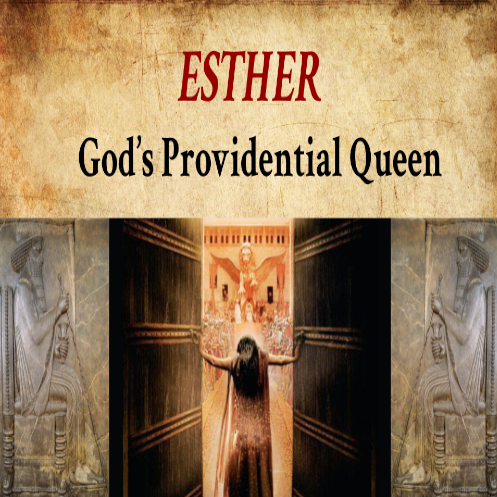
That image right there. So I put this up here. I've never seen this movie. It's a screenshot from a movie, I'll tell you, from one Night with the King. Never seen it. Not endorsing it. Don't know much about it. But I like the image a lot and I wanted to use it because it's about Esther. But this is the image I had when I was a kid. I thought it was cool. I did. I pictured this as a kid growing up hearing the story of her busting through those doors. I was pulling the story. Entering the King. We're kind of getting ahead of ourselves.
But I hope after tonight and the next few weeks, when we get to that point, it hits a little harder. I want us to have the same chills and experience Esther had and what that meant to go through the door. Yes, you went before the King. Yes, it was difficult, but there's a lot we have to do before we get there.
And this low born Jewish woman is about to save her people in a way that her ancestors failed a little bit. Okay.
So that's one of the themes. I'll move on here and put a few of mine up because tonight we're going to cover some of this. We definitely won't get all of it. But tonight and next week I'm going to do kind of a rapid fire history. We're going to set up. I want to set the stage, I want to talk about a little bit of everything.
And by next week, we're going to really get into that text of chapter one, Esther's about several things. And I've put some references up here. We're not going to look at them all. We're going to look at this all quarter.
But we see God's providence is assured. That's the big theme, right? Providence, not coincidence. Where historians see coincidence, we see providence at work. Right? We can prove it.
4:14, everybody's favorite verse from the chapter. I almost titled the class this, but I fought it because everybody titles it that. What's the phrase from Esther 4:14. Do you know it by heart?
Esther, perhaps. What?
For such a time as this. I love that verse. I do. And it's cool. It's really cool. It's such a great tagline. It's one of those mic drop taglines of Christianity for such a time as this.
And what a time it was.
This book is about us finding our own moment to have agency and responsibility to act.
This book proves that God is not a magician acting behind a curtain, just waving his hands. Right?
We're active.
We have a part to play in this narrative. That's a good thing. God invites us to, and it's required. We have agency and responsibility to act. God is faithful. We'll see in 9 and 10 when we see the comeuppance, the realization God comes through.
He uses ordinary, flawed people. We talk about that a lot.
And these people were. Was Esther a godly woman?
How do we define that? There's some things Esther is going to do that we wouldn't maybe call that.
That's part of it, right? There's a big narrative here. We're uncomfortable. We're going to have to talk about that.
We always reference growing up in the church with little flannel boards. Andrew talks about your little Bible story. And then Esther Vashti comes to the king and the king throws a beauty pageant. It's not a beauty pageant.
A little more lewd than that. We have to recognize that a lot going on here.
We will face uncomfortable circumstances and we must overcome them. In 5, 18, when we see Esther step up to the plate and walk through those doors, that's not a threat. It's not a question, it's a promise. God says you're going to face discomfort and if you want to survive this, we're going to come to that famous phrase later. There's comedy in the Bible, right? That verse where Mordecai says Esther, we're going to get Deliverance anyway.
But translated, he's basically saying, it sure would be nice if you would do it now. Right?
It is. God's going to come through.
Be nice if we did it now.
Evil is always lurking and we must be vigilant. In chapter three, it's a reminder that because the Jews disappointed God several times, that's why we're in this situation.
It's a reminder that characters like Haman, or Haman, I think was his name for a couple reasons, is still lurking in the corners.
So I want us to think about this quarter. Characters we can learn from. I want you to think about all the characters, not just Esther.
We're going to talk about Xerxes or Xerche, Ahasuerus.
Lot of different names for this guy. But yes, And I will say this. We 100% know. I do not like to say 100%, but we 100% know. This is Xerxes the Great, the king of kings, the king of many lands, the guy from 300. Okay. This is the guy who fought Leonidas.
He was.
And we're going to prove it.
This is why it's a frustrating book for historians, because for every single bit of evidence that says this is just biblical fairy tale, oh, another rock unturns and another uncomfortable bit of truth pops up. We have it. We have history, we have evidence, we have archaeology, we have everything we need.
It's not a guess. I want us to learn from Xerxes that, yes, there is a danger, specifically in a flavor of danger that comes from a man in power who told no. Right. He is a man who is told no.
And at least one woman suffers for it. A people's going to suffer. There's an Xerxes I don't want. He's not our antihero. But we're going to look, we have a lot of historical evidence. This isn't the first time this has happened, and maybe you didn't know that. If we look at Herodotus, Josephus, Thucydides, Theseus, all the great historians, if you go to an accredited college right now, they will have their histories and they'll make you cite them in certain papers. But they'll say, well, he mentions that, but we don't count. That doesn't work that way. Xerxes is here and we can learn. He's been through this before. We learn about the danger of bad influences.
We have evidence he had bad military advisors. Okay, you don't make. We'll talk about this, but they Had a tradition of making. Well, I mention it now. We have evidence of the banquet that was held in 480 BC. 43 BC. We'll get to that eventually.
But we do have evidence from Herodotus and contemporary historians who lived with Xerxes that they had a tradition in Persia, the royal kingdom. They would get together and hold their conference. Think about getting a lot of contractors together and military. So we're going to come up with our plan.
And they would drink until they got wasted.
Get the tongues loose and start getting your ideas out. Let's do that. They'd sleep it off and then come back the next day. And if they still remembered it and talked about it and it still sounded like a good idea, then they would do it. We have evidence this is how. The way they did their politics. And Xerxes does this and he listens to the wrong people.
Danger of revenge for perceived slights. And I say perceived. We have not only. I think we read too quickly. We read Esther 1 and he throws a party.
And then Vashti doesn't come out. And he gets mad, right? Gets upset. And it's all about Vashti and how dare she.
But this was coming for a long time.
And we'll get to that. Probably not tonight. Maybe. Maybe next week. But he was.
He's like his father. We have evidence. Him and his father had a problem for what we would call exotic women. Okay.
When they were supposed to marry within their Persian kingdom.
His father had a flair for this.
And his father had his own banquet that was ruined by some Greeks. Xerxes is going to take this very personally. And his advisors know what buttons to push and ultimately leads to their downfall.
Lack of control of desires. That's a theme. We're going to see that with Xerxes. The alcohol gets flowing.
Asks a lot of things of the women in his life.
What will Esther do?
Mordecai, Marduk or Mordecai? We're going to see evidence.
Well, I wish we could place them in history. There's just no way to do it. Except for we can. And we've got that evidence. I'm going to show you.
We know of a Mordecai who was in a position found in something called the Persepolis fortification tablets discovered in Persepolis. We can look at it.
Value in being an encourager. Mordecai is the ultimate encourager of Esther. He has composure under pressure. He's tactically minded, uplifting others for good and faithful and sure deliverance will come. He's the one who tells Esther, we need to be like that. Okay, another one just kind of quickly hitting the highlights. Vashti learning about what the power of no is, even if it costs you your station.
Historical note a lot of things about jealousy. I'm going to challenge something, though, that I think we've always talked about. Is it about modesty, maybe? Kind of, sort of. But I really don't think that's what's happening here.
I think we always like to say, well, Vashti was asked to come out naked. She had a crown on, and how dare you clutch my pearls. There's a little bit of that, but it's more than that. Xerxes was breaking laws he should not have done. Women had a lot more power than I think we realize in this society. We have evidence, but it's more than just lewdness.
It's about respect in a way that goes beyond physicality.
Was Vashti a real person?
Some historians say no. There's only one queen listed in historical records. Her name is Amestris. You can look it up, but guess what? It's the same person. I'm going to prove it to you. And it's not just Michael. It's fact.
It's the same person.
All right, getting on to Haman or Haman. Haman. We'll look at names. More of this tonight and next week, but I think Haman probably got his name. We have a lot of names in Judaism where we have Hebrews name their station. You know, they say, my child sick and tired. We had that lesson a few weeks ago. Rename what they're feeling.
Haman was the name of a deity, a chief deity for them.
But we learn from him the comeuppance of a treacherous heart.
We do see Haman and the gallows. A lesson about the destination of evil and God's vengeance is going to come up with Haman.
And I don't think it's a stretch. Once we look at the themes.
Esther. What do we learn from Esther? Courage against the uncertain. Bravery was mentioned. Certain that she must do what she must do, whether it costs her her life, patience, tact.
Esther is not just a pretty face. She very much is. It tells us she is beautiful. And if she's not beautiful by their standards, she doesn't get a seat at the table.
But she does. But she's not just a pretty face. That was put there so Mordecai could do his job. Mordecai does a lot of great things.
So does Esther. She's smart.
We learn about the power and resolve of standing for what's right. So a few goals for the quarter.
I want us to think about this each week, how this is not a fairy tale. I'll show little evidences here and there's a. Some of you can't see it very well, but small image of the immortals. We have these from Persepolis and Susa and Sardis palaces. All these colorful palaces. They like the color blue and white and ivory. Going to see that in Esther 1.
His soldiers, the military presence. We'll talk about the mythology, significance later. The significance of a bull and a lion, what that meant, context for our motivations. Though there's a lot going on here. Esther is a book of symmetry. Will taught a class on the mountain of God last quarter and talked about the literary themes we see God employ.
Esther is a book of symmetry. It's specifically written like a fairy tale, but it's way too specific to be a total fairy tale. It's kind of written like one, but doggone it, you look at it and just. There's things about it. The most stringent historian has to say, why do they know this?
It's too accurate.
There's reasons for that.
There are cycles of redemption and exile that happen.
I want us to look into this quarter. The events around the text again, the evidence of things unseen. We actually can tell a lot by what's mentioned around Esther. Can I prove. And can we prove that Esther, the woman, lived and was queen of the palace without any doubt? No, not really. Not from a history standpoint, but we can prove it because of everything else that's there.
We can, we can.
We're going to look at banquets. We're going to talk about banquets. What was the protocol? Haman, Mordecai, what do we know? What can we know?
And I want us to do this. I'm not criticizing, but typically when we teach Esther, it's just in the ladies class. I don't mean just the ladies class. It is. It's a great lesson for women, Great lesson for men.
I want my son and daughter both to look at Esther and say, that's a hero. I want my son and daughter both to look at Mordecai and say, that's a hero. Right?
We're missing out, guys.
We're missing out, ladies. When we just look at one part, these are God's children. We're going to look at that.
We're going to look at evidence like this to the side. This is something that will come up later. It's one of the few women statues of women we find in Persia. Not even sure it's a woman. It might be a beardless man. There's a lot of things with archaeology we're going to look at. Is this a queen? Not sure.
I want to look a little bit in the time we have and next week I want to set up the stage of where we're at in history. I think one thing a misconception we need to address is we tend to view history as now and Bible times, right? With a big old tm. Bible times. Everybody's living in a tent in the desert, just waiting on somebody to show up. I'm just trying to say you kind of see that it's not that way. These people were complicated, had cities and science and medicine, arts. And we're going to see that. Where are we at in 480 BC? And yes, we know the story is in 480 BC without a doubt.
How did we get here? What's the timeline often, Esther, Nehemiah, Ezra, Daniel, these books of persecution, cycle of return.
When did all this happen? Which book came first? We're going to look at that in the quarter.
Persian culture. Look about that a little bit through the quarter.
Greeks versus Persians. If you're a fan of history, if you know anything about Britain and France, you ever read about them in history and how much they hate each other and you read one thing, that's what these guys were. Hated each other, but also kind of loved each other, right? Loved their culture. But there's a lot of similarities and it's ultimately what brings down Xerxes.
He won't let some things go. Okay, how big was Persia? We know Rome was big. Persia was huge too. Banquets, oh boy, are there stuff they've written about banquets. They love to eat.
Herodotus records for us that when he was recording the Persians, we would have done well with Persia for a point. I think as southerners, they were the first culture to introduce multi course meals.
You know, the idea of bringing out a few. Then they brought out the meat and Herodotus says they brought out good meat. They brought out steak and all this stuff. And then they would have like eight or nine courses of desserts, baklava, things like that. And they'd just eat and eat and eat and eat and eat. And the Persians would say, hey, Greeks obviously don't have good desserts because if they did, they wouldn't get up from the table and they'd shut up while they're eating. They'd make fun of each other and say, hey, if your food was as good as ours, you wouldn't get up either. They hated each other. They took stabs at each other.
And we're going to talk about what is a Persian queen. That's one thing I want us to challenge. When we read the text, I'm going to be referencing a lot of older texts. Newer texts, I like to use an interlinear Bible, if you've got one of those. Because when you look at those Hebrew terms, some things start to make sense.
When you look at old texts, I like to do research. I mean, I'll consult all the Bible commentaries, old and new.
Secular commentaries work too.
We learn a lot.
Esther, Vashti, Xerxes, Mordecai, Haman. Who are these people?
Secular history. We're going to look at all that. So one thing I want to talk about tonight is the form of Esther, Okay? The book, it's a chiastic structure. There's your big word for the night.
It's about parallels and repetition on purpose. It's a form of literature. And I'm not just pulling this out so it looks good. It's just the Bible's written this way. When Hebrews are involved, writing for a Hebrew audience, we see it in the poetry. Go read Psalms. Pay attention. How many times they'll repeat themselves. Right? When Hebrews would repeat themselves, that was their exclamation point. I say to you, go do this, go do this.
They would rephrase things. Esther is written in a chiastic way in Matthew is very similar, if you see my meaning. Abba. Not Abba the band, but Abba the structure.
Whoever exalts himself will be humbled. Whoever humbles himself will exalt. See how it's a mirror. Well, Hebrew Esther is written that way too. If you think about it, we see a lot of things that happen. Mirror in the second half, right? You ever thought about it? We begin with a feast and we end with a feast. A celebration.
Decree to destroy the Jews, decree to save the Jews.
Two different foiled plots happen over the course of this book. You can't really read this from here, but this is how Esther's written. It's like a big arrow. Think about it and see how it mirrors. Vashti is queen. At the end, Esther is queen. Mordecai, who I got this for. Mordecai uncovers a plot to kill the king. Mordecai is elevated, taking Haman's place after it. Right? Haman plans to destroy the Jews.
You know, Haman is destroyed by the Jews. It goes on. It's written that way on purpose so God can show us his providence as well.
Any comments before I go on? Anybody want to shout to the rooftops or disagree with me yet or any comments?
Yeah, I'll make them available at some point.
There's a lot. And we're going to go through this this week. And next on History. So what I want to do now is get us set up so that when we do, probably toward the middle of class next week, go to Esther, Chapter one, verse one.
And we say now is the time of Xerxes. I want us to be ready.
So quick backdrop here. This is not a full. We don't want to go through all the kings here, but we need to know a few things, okay? Because this was a time of change.
The 5th century is what we're trying to get to. But a few things to note. What was the world like?
8th century, we have Rome founded thereabouts. Not the Republic, but it's upstart. Rome is coming. I'm sure nothing will amount to those guys, right? That's how the Persians thought at first. Ancient Olympics began in Greece. 700 Sennacherib wars against the Judeans, 701 BC.
That's what's going on here. And we have biblical evidence that aligns with this very well.
7th century, Babylonians and Medes burned Nineveh. We've heard of Nineveh, right? Babylon marking the end of the Assyrian empire in the 600s, 6th century. And I'm saying this because the times, they are changing, okay? By the time we get to Esther, politics have changed. Egypt's not the big dog anymore, right?
Rome's not there either.
We have something called the Age of Philosophy. We know Nebuchadnezzar sacks Jerusalem in 588. We have biblical text for that. Guess what? It matches historical record.
Greek philosophy as we know it is born in 585 BC. These are the beginnings before we get to Socrates and all that Thales of Miletus, all that stuff. Cyrus the Great, and this is a big one, if you've heard of him.
5, 50. And this is leading us right into our story. The Greeks are starting to colonize the Black Sea. The Persians don't like it. They push back. And eventually we have Cyrus and the Cyrus cylinder. Some of you may have seen that before. The Cyrus cylinder is one of those things that makes the Bible work from a historical standpoint because we discovered it at one of their cities. And it talks about all this stuff. It Talks about Cyrus freeing the Jews, all the people. The Jews loved him because he freed them from their captivity. When Cyrus and Persia tackle Babylon in the 6th century, we see Cyrus and Persia defeat Babylon. So we have a long history in the Bible of Israel and Judah go down, Assyrians take them. Babylon takes Assyria, Persia takes Babylon. And here we are. Egypt is gone. Egypt has fallen a lot by now.
In 539 B.C. which we see in the Bible and can triangulate. If you read Daniel, Ezra and Nehemiah, it all works out.
They say the Jews can go home.
Egypt falls to Persia. The Roman Republic is founded. Still, don't worry about those guys yet.
The Athenians are starting to really get democratic in the 5th century for such a time as this. This is our setting. Okay. When we're getting up to the events of Esther, we see Greek drama begin. Why am I talking about this? Because at this time is when we see history born the way we do history. Right. Herodotus, the idea where people would go on site and interview people. That's a crazy idea. Go on site and find out what happened. They wrote plays that started to narrate, much like the old myths of Troy to tell us our history, which we have records of.
It's the time we see culture change. When everybody's fascinated by philosophers like Xenophon, Plato, Darius I or Darius. However you want to go. I'll say Darius. And the Persian Greek wars began in 492 BC which again, we're brushing right up against what's about to happen. This is after the Medes, but it goes on for a long time. Darius the first is mentioned in Daniel and other places. Which confirms the chronology.
Darius or Cyrus. Then Darius and then guess who comes next? Xerxes, Siddhartha, Gautama. In the world, everyone wants to know what's going on. That's the Buddha.
Buddhism's picking up. Okay.
Confucius. All these things are happening. So we see Xerxes confirmed in a variety. This is a statue of one of the Socrates somebody. I think that's. I forgot my citation. So I have to go to Socrates. But down here was one of the tablets we have that talks about Xerxes rule. So a couple of maps just to kind of show us where we're at when we're talking about Persia. This is. The Persian Empire is going to take over a lot. We think about Iran, right? It's not the same as it is now. But they did call themselves Iranians at one point. Meant a little different.
This is today.
This is Then see that this is then just to have an idea of where we're at in the world.
That orange blob is the Persian Empire. So when Esther1 says Xerxes ruled 127 provinces, which we'll get to, that is the right number. It's not 20. We'll prove it.
There's evidence and fight on this amongst historians. But it's not true. The Bible's right on this.
Persia goes from India basically all the way to Libya, right?
This is a massive empire.
I put this one up just to get an idea, you know, this is our empire, okay? We're going to see a lot of these cities mentioned. Look here. Here is Persia, Elam, the Elamites. Susa is where our story is going to take place. And the great city of Persepolis, okay? So way over here, Persia had several main capital cities.
Persia, they had Persepolis, Susa, Babylonia, which is just Babylon. They take them to Babylon and then we're going to see them go up to Sardis and you're going to recognize some of this from biblical lit. And there's Greece, okay? So this is what we're talking about. The Persians are pushing over against Greece. And see that little boot there? That's Rome. They're not important yet. And the Persians are like, that's fine. I'm sure that won't matter. That comes around much later.
Whoops. There we go. So a couple things I wanted to show tonight and the time we have is I want us to think again about where is God?
In Ezekiel, we see.
I want us to remember this. We're in a period of silence in a way, right?
Because the Jews are in exile.
God is present. But we know many times in the Bible he tells what's going to happen. Because they dealt treacherously with me. I hid my face from them and gave them to their adversaries.
God says this in Deuteronomy and Isaiah, right? We're seeing that happen. God is silent in a way, but he's present in other ways.
Just to kind of catch up to what's going on with Judah right now. Before we get to see where we came from, remember the northern and southern kingdoms split in about 9:30. We see Assyria take them.
Israel and Judah are split, right? And over time, the exile happens.
We know from 2 Kings telling us about King Jehu, right, who was sacked by the Assyrians, he eventually lays down to Shalmaneser iii.
We know that because in the British Museum we have the black obelisk of Shalmaneser iii, which, while having a very, very cool name, is very, very much a historical record that Jehu is on here in the Bible. It's in reality. This right here is Jehu, one of the last kings, the great Jehu killed Jezebel, bowing down, and we see the dominoes fall. We have evidence from history where Jehu is mentioned. The son of Omri, Ahab's family. That's how they were referred to.
They just lumped them all together.
After that, we see what happens with the Assyrians. We see guys like King Tiglath, Pileser of Assyria. This is him take down and carry away the people to Assyria, which gets us a little closer to Persia from Judah. We have this evidence in history as well.
We have things like the Taylor prism. I just want to show these evidences. We have proof, people, you know, if we got it, I want us to be confident in our faith. Because for every Bible verse, there's an artifact, okay? It's out there. Sennacherib of Assyria, we know, took down a Judahite city, which by this time Israel is getting gone. And the people know Judah. And then eventually it just becomes Yehuda. And they're just Jews. By the time we get to Esther, they're just called Jews. But they've lost what that meant, right? It's an ethnic term.
Persians don't care.
Just another storm, God from the plains, right?
They've lost their way.
But we see. I want to say this before the bell rings. This is one of the funny examples right before we get to Persia.
You know, this is the story in the Bible where Sennacherib shows up to take Hezekiah and an angel of the Lord slays all of his people and he leaves. Well, conveniently, this one battle, Sennacherib claims victory over 46 other cities. And when he writes a monument about this one, he basically says, we'll call it a draw, right?
But we know it happened.
So that is that time. I want us to pick up here next week. I want to show a few more things that get us from showing how we get from Israel, Judah, Egypt, Assyria, Babylon. And we're going to walk right into Persia.
And next week we're going to look at the names and see how we see Vashti and Amestras and all these people show up.
I hope you'll think about that for next time. Go ahead and read Esther 1. At least the first 10 or 12 verses, maybe the whole chapter, if you're feeling.
Feeling like it. But we'll talk some more about the history then. So thank you for your time. I hope you enjoy it.