[00:00:00] Speaker A: Hey, thanks so much for listening to this message. My name is Jason and I'm one of the ministers here at the Madison Church of Christ. It's our hope and prayer that the teaching you hear today will bless your life and draw you closer to God. If you're ever in the Madison area, we'd love for you to stop by and study the Bible with us on Sundays at 5pm or Wednesdays at 7pm if you have questions about the Bible or want to know more about the Madison Church, you can find us
[email protected] be sure to subscribe to this podcast as well as our Sermons podcast, Madison Church of Christ Sermons. Thanks again for stopping by. I hope this study is a blessing to you.
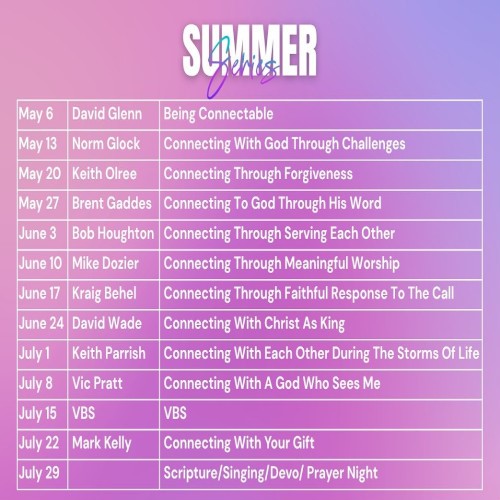
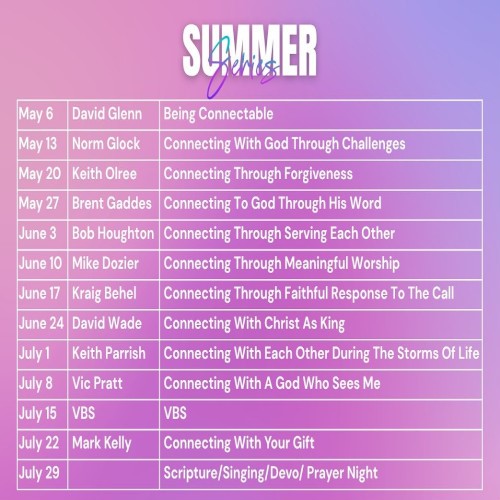
[00:00:38] Speaker B: Good evening. What a blessing it is to be gathered here tonight to have the chance to study God's word. Tonight we're gonna be continuing our summer series going through letting our eldership teach Us. And so Tonight we've got Mr. Mark Kelly teaching us tonight, and I know that'll be a blessing to each of us. Before he gets into it, I'm gonna be kind of sharing a little quick bio. I actually have the opportunity to spent an afternoon with Mr. Mark and his wife, Ms. Becky, and that was a great afternoon spent. They filled my belly till it was overflowing and we had some great conversation. So I know I'm thankful for them and I know what a blessing they are to so many of us here.
Mark and Becky Kelly moved to Madison, Alabama from North Carolina in 2001, coming home back to Alabama after about 20 years living in North Carolina. And they noted it was quite the change leaving North Carolina, the state of all things basketball, coming to Alabama where everything is just football, football, football.
Mark was raised in Talladega and Becky was raised in Huntsville. Mark retired a year and a half ago from the government contracting industry and Becky still works as one of the licensed professional counselors for the Madison Church.
This was something I got to spend some time talking to Ms. Becky about and I know it was just wonderful to see some of the insight of that ministry and so amazing to see some of the things that she's getting to do for the Lord in His kingdom. Mark became an elder almost 13 years ago and he enjoys serving alongside the other 10 men who have already taught this class this quarter. Mark and Becky have three children and seven grandchildren.
Mark's hobbies include his koi pond in the backyard. And if you guys have not seen that, I would recommend it because it is one of the coolest things I've ever seen some legit engineering going behind that.
He and Becky both competitively shoot rimfire rifles and pistols and it was noted by Becky that she wanted to make it clear that she is more accurate, but Mark is faster.
I think either way I'm probably not going to mess with either of them.
They both have a lot of love for the church in Ukraine and they just got back from a trip where they had spent two weeks in that country. So it's amazing to see all the things that they're doing for the Lord's Kingdom. And tonight I know we'll be blessed by Mr. Mark.
[00:03:05] Speaker C: Thanks Trent for that introduction.
Just so we educate you a little bit more.
It's Talladega. Like you dig a ditch Talladega. There's others here from there who know that.
Now you got it right.
But it's great to be here tonight with each and every one of you.
And as was just mentioned, Becky and I just got back from Ukraine a week ago tonight and the picture you see on the screen is most of the 400 Ukrainian Christians that came from all over the nation of Ukraine and gathered together gather there in Lviv, Ukraine for Camp Amerikrane.
And it was a great, great event. There were some other things that we did before Camp Americrane primarily Becky and Darren and others. So we'd love to tell you all about that two week period. So put it on your calendar for Sunday, September 20th. I know that's a couple of months away but we'll be talking back in the fellowship hall at 9:45 between the two services and we'd love to have you come here. All about the work that occurred over the last couple of weeks.
Two of the folks that will be helping in that presentation, Will and Jenna Harrison.
Jenna is Jordan Abrams sister and Will is the brand new campus minister for Madison Academy. And we just got them all moved into their house to nights ago and so when you see them here, welcome them. They haven't officially met with the elders yet, said hey, we'd like to work and worship with you guys here but we think that's coming. So be sure and welcome them when you see them.
Also, another quick announcement before we get going with class is it's almost time for Bible bowl and so there's going to be a Bible bowl kickoff at our house and it'll be on Saturday, October, August 25th. August 15th. So we'll start around four and kick everybody out about eight o' clock or whenever you need to leave. It's kind of a come and go but we'll have food there and we'll have an opportunity for you to bring some food as well.
Patrick Butler and his wife Jordan do a great job of that ministry, and so they're going to get some information out about that and how you can sign up and participate in that. We just love for you to come by, especially if you're new to Madison, you've never had your child involved in Bible Bowl. Come and talk to some of the parents who have been in it for a while and talk to some of the coaches and just kind of get an idea of what it's like if you're trying to make that decision. Do I put my child in Bible bowl or not? Love to answer your questions and just have a good, good time of fellowship in the afternoon. This year they're studying the Book of First Kings, and that's a great book because it starts with King David at his old age and moves through King Solomon and then it ends up with King Ahab of Israel and King Jehoshaphat of Judah. So it would be a great study for kids. And y' all come if y' all want to participate in that.
So tonight is our final lesson in our summer series on connecting.
And next week we're going to be closing out our summer series with kind of a special time together in songs and prayer, some scripture reading and some. Some closing comments, but all around the idea of connecting, just emphasizing a lot of things that all the shepherds here at Madison have been talking to you about this past quarter. So be looking forward to that.
My topic tonight is going to be connecting with our Gifts.
Now, what do I mean by a gift?
You may be picturing a pretty bag or a pretty box that's got ribbons on it and that kind of thing.
And yeah, that is a gift.
And if you look up in the dictionary about what a gift is, you may find something like this, that it's a voluntary transfer of something like money, property, or an object to another person without expecting anything in return.
And that is a true definition of a gift.
But I want to show you what I'm talking about as far as what a gift is.
That is going to be part of our discussion for tonight.
So this young man is Daniel Ellis. You may have seen him before. He's been up here leading, singing on Wednesday nights. Does a great job.
Really, really smart young man. As you're fixing to see.
His mother's Malia. His father is Jake. Jake's one of our deacons here, and he has a brother named Luke and Daniel Has a gift.
And I wanted you to see his gift. So his dad, Jake is asking him questions about the 2025 football playoff teams. He's asking records scores, who their opponents were and that kind of thing. And Daniel's going to answer the questions. So take a look.
[00:07:59] Speaker D: What was Alabama's record?
[00:08:00] Speaker E: 11 4.
[00:08:01] Speaker D: What was Tennessee's ain't 5. What was the Texas ball game score?
Who did they play?
[00:08:10] Speaker E: Michigan.
[00:08:11] Speaker D: What was Texas record?
[00:08:13] Speaker E: 10 3.
[00:08:14] Speaker D: What about Michigan's 9.
[00:08:15] Speaker E: 4.
[00:08:16] Speaker D: What about Indiana's?
[00:08:18] Speaker E: 16.
[00:08:18] Speaker D: Now what was the Alabama Indiana final score?
[00:08:21] Speaker E: 33.
[00:08:22] Speaker D: What about Indiana? Oregon.
[00:08:25] Speaker E: This is the title.
[00:08:26] Speaker D: What was Miami's record?
[00:08:29] Speaker E: 33.
[00:08:30] Speaker D: What was the Indiana Miami final score?
[00:08:32] Speaker E: And then remind me, was Tyler Tyrone.
[00:08:35] Speaker D: What was Oregon's record?
[00:08:37] Speaker E: I'm 13. 2.
[00:08:38] Speaker D: What about Ohio State?
[00:08:40] Speaker E: I'm 12.
[00:08:43] Speaker C: Okay, no need to fact check. They're all right. Every single one of those is right. And that to me is just amazing. Just totally amazing. That is a gift that this young man has. Now you may be sitting there thinking, well, that's just numbers and names. You know, a lot of people can do that. Okay, let's step it up, Step it up. Let's throw some graphics at this young man and see what he can do.
[00:09:04] Speaker D: Okay, are you ready to do some hard countries?
[00:09:07] Speaker E: Yes. Can I watch it down?
[00:09:09] Speaker D: Well, I'll show you the flag and you tell me what the country is. Okay.
Are you ready? Come over here so you can see the flag with me. All right.
[00:09:19] Speaker E: Montoya. I know that. Okay, but I can see.
[00:09:23] Speaker D: Okay.
[00:09:25] Speaker E: Honduras.
[00:09:26] Speaker D: Honduras.
[00:09:28] Speaker E: Burundi. These are a few. Easy.
[00:09:31] Speaker D: Oh, easy.
[00:09:32] Speaker E: Okay.
[00:09:35] Speaker D: Slovakia.
Solomon Islands.
Kiribati. I guess how you say it.
[00:09:47] Speaker E: Fiji.
[00:09:48] Speaker D: Fiji.
Myanmar.
Chad.
[00:09:57] Speaker E: Stay south.
[00:10:01] Speaker D: That one.
[00:10:04] Speaker E: Micronesia.
[00:10:05] Speaker D: Federate. Yeah. Micronesia. Federated States. Micronesia.
[00:10:09] Speaker E: Tonga.
[00:10:11] Speaker D: Tonga.
Cook Islands.
[00:10:15] Speaker E: Georgia.
[00:10:17] Speaker D: Georgia.
[00:10:22] Speaker E: Boys.
[00:10:24] Speaker D: Boys.
Peru.
[00:10:28] Speaker E: Cambodia.
[00:10:29] Speaker C: Cambodia.
[00:10:32] Speaker E: What is this?
[00:10:34] Speaker C: What do you think?
[00:10:36] Speaker D: Dominican republic. Yeah,
[00:10:43] Speaker E: Try that. A Tobago.
What is this one in Uzbekistan? I believe.
[00:10:52] Speaker D: You believe it's that one?
[00:10:55] Speaker E: Yeah.
[00:10:56] Speaker D: Uzbekistan.
[00:10:57] Speaker E: Central Africa.
I knew those.
[00:11:01] Speaker D: Wow. Daniel,
[00:11:05] Speaker C: he said those were easy. Well, that to me is just mind blowing because I do not have that gift that that young man has.
But I showed these videos to you to impress upon you by what I mean by gift.
And it's not that if you can't do what Daniel can do, means you don't have a gift.
But that your gift is something that you are good at, that you can share with others.
And the gift that you have may not be a God given gift. Those gifts that Daniel has are truly God given gifts.
But it may Be that you have a gift that God has given you the ability to learn.
So we get gifts two different ways. They're God given or God gives us the ability to learn that gift. And there's no other reason why you would have that gift. God was involved in some way with your gift. And Paul writes about that.
He wrote it to the Corinthian Church in First Corinthians 7:7. He says, I wish that all were as I myself am, but each has his own gift from God, one of one kind and one of another.
So, Mark, what are your gifts? You may be thinking and asking me. Well, I would say that my God given gifts is my engineering mind.
Now, Becky may argue that that's a gift because she's not too keen on the fact that I can take a broken dishwasher and fix it when she'd rather have the shiny new one.
So maybe that's not a gift in her mind. But there are some other gifts that I believe that I have learned along the way.
Some of y' all know, most of you probably don't know that in my high school and college days, I was a radio disc jockey. And I did not naturally have a radio voice, but I had to develop it and work on that.
It was a gift that I had to develop and learn.
I'm not using my radio voice tonight, and I will not use my radio voice tonight. That's a code us radio guys have. We don't give you our radio voice unless you can't see us. So I do have a reel to reel tape, and if you have a reel to reel tape player, bring it to the house and we'll listen to my radio voice. But until then, it's kind of going to be a secret song leading. Y' all have seen me lead singing before, and that was something I had to learn. I learned, started learning that in college and developed it through the years.
So I feel like that I'm a pretty decent, maybe not the best song leader by any means, but I feel like song leading is. Is one of my gifts. And then I just found out in the last six months that I am a bathroom remodeler.
I did not know that. And that was a gift that I had to learn.
It only took 372 YouTube videos to learn how to do that.
But you can see here the. The image of our old bathroom.
And after watching all those YouTube videos and after Becky did her design part, this is what I want it to look like. This is what it needs. The color, colors and all that kind of stuff. I was able to turn it into this.
So I'll say, I now have the gift of remodeling bathrooms. Now, there's good news and bad news to this gift. The good news is I can come do this for your house.
The bad news is you cannot afford me.
You can't.
So here's the real question.
What are your gifts?
I want you to think about that for a moment. What are your gifts?
And don't just sit there and say, well, I really don't have any gifts. Yes, you do.
Everybody in this room has a gift or multiple gifts given to you by God, or God gave you the ability to learn those gifts.
And if you're too humble to identify your gift, I know there's somebody in your family or your close group of friends that can point out what your gifts are.
You've heard people, been with people that say, hey, you know, so and so, man, they're really good at this.
And there's somebody in your circle of friends and family that can do that and identify your gifts for you. But, yes, everybody in here has gifts.
Now, why do we have gifts?
It's kind of an interesting question.
Why do we have these abilities? Why do we have these gifts? Have you ever thought about that?
This person is good at this, and this person is good at that.
Well, God gave us these gifts for a reason.
It's just not because we're humans and humans have gifts. God gave you your gift for a reason.
And when Paul wrote his letter to the church in Rome, he talked about gifts. He talked about that. So I want us to look at this tonight. We'll be looking at Romans, chapter 12.
We're going to begin in verse three. I don't have the entire scripture that we're going to be reading on the screen, so if you'd like to turn there, turn to Romans 12. Starting in verse 3, Paul writes, For by the grace given to me, I say to everyone among you not to think of himself more highly than he ought to think, but to think with sober judgment, each according to the measure of faith that God has assigned.
For as in one body, we have many members, and the members do not all have the same function.
So we, though many, are one body in Christ, and individually members one of another.
And then look at verse six.
Having gifts that differ according to the grace given to us, let us use them.
Verse 6 does not say we all have the same gift.
I can't remember things like Daniel can remember. In fact, I'm quite the opposite of Daniel. When it comes to memory and recounting things like that, maybe you can't remodel a bathroom like I can, but you have gifts that I don't have.
We all have different gifts. And then Paul writes, let us use them.
And you know, as many times as I have read Romans 12 and I've read it a lot, it wasn't until I studied this class that I saw those four words, let us use them.
Are you using your gift?
Paul says, we need to use them. They're God given.
Let's use them.
And he talks more about that here in a minute. But I've never noticed these four words before.
As we continue on in the Scripture, he goes through this list of gifts. And these gifts are what every church would need.
These gifts are what the Madison Church has. There are people in this room that have every gift that we're fixing to read. Paul says, let's use them.
Continuing on in verse six, he says, if prophecy in proportion to our faith, if service in our serving, the one who teaches in his teaching, the one who exhorts in his exhortation, the one who contributes in generosity, the one who leads with zeal, the one who does acts of mercy with cheerfulness.
Now, this is not an exhaustive list of gifts. There are a lot of things that we can put on a list that we could call a gift that you're good at and that you can share with somebody else. That's not on this list.
But Paul is pointing out some really key, important gifts that every church needs and that we should be using these gifts.
So I want us to look at each of these briefly while we have time tonight. And so we'll begin with the first one which she mentions is prophecy.
Prophecy would be speaking forth God's truths as directly revealed by the Holy Spirit.
In Paul's time, when this was written, prophetic teachings were very, very important. The church was brand new. The church was growing. The church was getting started.
It was in its early stages, the written New Testament. Major portions of it were not readily available to the church.
And in absence of the writings of Jesus teachings and in absence of the New Testament, they needed prophetic teachings.
Now, one good example of a prophetic teaching is when we read about Philip.
He was led, he was directed by the Holy Spirit to go see the Ethiopian eunuch who was taught by Philip. He was baptized by Philip, and then the Spirit took Philip away. So the Spirit was guiding Philip through the whole event there. So the eunuch received prophetic teaching from Philip.
And on this particular gift of prophetic teachings. We need to remember what Paul wrote to the First Corinthians in the book of First Corinthians in chapter 13, starting in verse 8, he says, as for prophecies, they will pass away. As for tongues, they will cease. As for knowledge, it will pass away.
For we know in part and we prophesy in part, but when the perfect comes, the partial will pass away.
So now that we have the written New Testament word, now that we have that in our hands and it's readily available and everybody can get a copy of it, prophetic teachings have gone away.
So this is not a gift that anybody in this room is going to possess.
This one has passed, this one is gone. Let's look at the others.
Next on the list is serving or service.
This is a very broad subject, serving or service. Very, very broad.
But since it is broad, this is the one that everybody, everybody in this room has this gift or some form of this gift.
I don't know what it is for each of you, but everybody in here can serve in some form or fashion. What specific gift of service do you have?
Can you cook for someone who's in need of food?
They're at home ill and can't cook for themselves.
Can you clean someone's house or mow their yard because they are not able to get out and do that?
Can you encourage the incarcerated or encourage the sick who are in the hospital?
Can you visit a lonely person and spend some time with them and brighten their day?
Can you sit with the kids of weary parents so they can have a night out?
There are so many things that we can do and you're good.
It may be one of those or something else that I haven't mentioned.
The list of service type gifts is absolutely enormous.
Now I have no idea if Paul made this list in a certain order, whether it's in order of importance, but if it is, you know, prophecy was like number one, but that's now passed. Serving would be number two. If there is a priority in this list, Serving is the number one way you can connect with another person.
Why?
It puts you face to face with that person.
You connect with them when you get face to face and serving gives you the opportunity to do that, it takes your time to perform an act of service.
There's been research out there and there's research published by the association for Psychological Science and they found that when people spend time on others, it actually relaxes their own perceived time constraints and boost self efficacy.
This feeling of giving also leads people to commit to more future engagements with the recipient, thereby cementing that relationship.
From journal social humanity perspective, they say studies on pro social behavior such as volunteerism indicate that helping others not only creates a shared identity, but also fosters empathy and trust and mutual obligation, which are foundational for stabilizing long term relationships.
Paul says to use your gifts of serving, not to check a box, but to help you build that long term relationship that you need with other people.
And in doing so, that builds a strong church.
Paul mentions teaching.
It makes sense. If serving is an important gift, teaching would also be an important gift to use.
We have a large number of teachers here at Madison. It is such a blessing to have so many that can teach adult classes and our children's classes.
Some of those teachers were born teachers and you know, some of those man, that person just, it just oozes out of their pores. You can just tell they were born to be a teacher. And some of us had to kind of learn how to be a teacher.
But either way, you can have that gift of teaching, whether it's natural born, God given, or whether you have to learn that gift.
If you don't have this gift of teaching, let me encourage you to learn this gift.
We need teachers.
I always learn more when I teach.
And if you ever teach, if you ever taught, you'll probably say the same thing. When you teach, you learn more than the class will.
So just from this, from that standpoint alone, I encourage you to learn to teach and do that.
We're expanding our building in the back.
More classrooms. Guess what? More classrooms requires more teachers.
We've got some classes that are too big, they're overflowing. We need to split them up.
So to do that, we've got to have more teachers.
And God's going to provide. I have no doubt that there's teachers that will be in that new building teaching that are not teaching today because you've got that gift or you've got that desire to learn that gift. So again, let me encourage you to develop this gift and to teach.
Paul mentions exhortations.
Well, that's not a word we use every day, is it?
Well, did you hear that exhortation Jason did the other day? Wasn't that great?
We just don't use this word. So do you know what an exhortation is?
Well, it's a powerful, earnest communication intended to strongly encourage, advise or urge someone to take a specific action.
It's a persuasive appeal designed to inspire rather than command.
Exhortations are important in relationships, in churches. In families, because they're not about commanding, they're about inspiring.
We need to inspire each other through our exhortations with each other.
Paul provides an exhortation to the Roman church and it's from the very same chapter that we started reading out of.
And this is in Romans 12:1 2.
He says, I appeal to you brothers, by the mercies of God, to present your bodies as a living sacrifice, holy and acceptable to God, which is your spiritual worship.
Do not be conformed to this world, but be transformed by the renewal of your mind that by testing you may discern what is the will of God, what is good and acceptable and perfect.
These two verses have inspired the church for almost 2,000 years.
I know they've inspired me and I know they've inspired you.
Is this one of your gifts?
Can you inspire people to do the right thing?
If that's your gift, we need you to use it.
And everyone in this room, me included, is going to benefit from from your exhortation.
Next is contribute in generosity.
Well, while it's nice when you contribute generously, that is not the same as contributing in generosity.
Sounds very similar, but it's very different.
So let me explain. Paul isn't saying if you have lots of money, then give lots of money. That's not what he's saying.
When you contribute generously, it means you are giving a large sum of money, that you're being liberal, that you have a plentiful amount that you have and that you're giving it to someone.
But when you contribute in generosity, it means your act of giving is motivated by the virtue of generosity itself, focusing on the intention and selflessness of the gift rather than just its size.
Research from the University of Alabama in Birmingham states that giving in generosity, not giving generously, but giving in generosity fosters deep social connections, builds community trust and actively triggers a psychological helper's high, inspiring recipients to pay it forward and sparking positive ripple effects in society if you don't have it naturally.
The gift of giving in generosity is one that we all need to learn.
What about leading?
Leading with zeal, Biblical leadership.
And there's a lot about biblical leadership in the Bible. I spent quite a bit of time in Ukraine speaking to the men about biblical leadership and about elders and that type of thing while we were over in Ukraine.
But biblical leadership is rooted in servant hearted influence rather than power.
Leadership is not about biblical leadership is not about power, it's about servanthood.
It prioritizes humility and integrity and self sacrifice over one's status and it operates under three primary metaphors.
One, being the servant who puts others needs first the shepherd who protects and guides, and then the steward who manages God's resources correctly.
The church needs good leaders.
If this is your gift, lead, put it to work. Be a leader.
You can learn how to lead. If it's not natural to you, you can learn. But be a leader. The church needs good leaders.
And then acts of mercy is the final thing in the list.
And Paul includes acts of mercy as he continues the text in Romans 12. 9. I'm not going to read all of these. I'm going to jump down actually to verse 14.
But as I read these, look at these as acts of mercy. Verse 14. He says, Bless those who persecute you.
Bless and do not curse them.
Rejoice with those who rejoice, but weep with those who weep.
An act of mercy.
Live in harmony with one another. Do not be haughty, but associate with the lowly.
Never be wise in your own sight.
How easy is it for us to look down on someone?
It happens that quick. We can look down on someone.
Paul says, no, it's an act of mercy to be on the same level.
Never look down at someone.
Verse 17. Repay no one evil for evil, but give thought to do what is honorable in the sight of all, if possible, so far as it depends on you. Live peaceably with all, beloved. Never avenge yourselves, but leave it to the wrath of God, for it is written, vengeance is mine, I will repay, says the Lord to the contrary. If your enemy is hungry, feed him. If he is thirsty, give him something to drink, for by doing so you will heap burning coals on his head. Do not be overcome by evil, but overcome evil with good.
Peter also writes a very important teaching in his letter or one of his letters. First Peter 4:10. He says, or he writes, as each has received a gift, use it to serve one another as good stewards of God's varied grace.
Now, where do you use your gifts?
We've talked about what your gifts are. Hopefully you've thought about what your gifts are.
But where do you use your gifts?
I would dare say that most of us typically use our gifts in our circle.
What I'm talking about is that group of friends or that group of family or both that you are spending most of your time with, that you communicate with the most, that you're with the most. That's your circle. It's your circle of family and friends.
And that's where you typically will use your gifts.
And there's nothing wrong with helping Your friends and helping your family by using your gifts with them.
That's the group of people we look for first when we walk in the doors.
When you walk in the doors, you're looking for somebody you don't know or you're looking for somebody you know.
We're looking for our circle. When we walk through the doors, we feel comfortable with them.
It makes sharing our gift with them easy.
Human beings are inherently social beings, and we naturally will navigate toward our trusted circle of friends and family. It's just a natural thing we do sometimes. This behavior is called social homing.
It provides emotional security for us.
It provides a strong support system for us and a sense of belonging, especially when we're in some sort of an unfamiliar situation, unfamiliar place, unfamiliar problem.
We go to our circle to receive comfort from our circle. Nothing wrong with that.
Unless that's all we do.
Unless that's all we do.
I want to try to represent this graphically.
So let's let this oval be the Madison Church of Christ.
So anything that's going to be inside this oval is going to be members of the Madison Church of Christ.
So in this circle, in this church, I'm going to put myself and I'm going to put you, and I want to put all of our circles in there. So here we are, you and your circle of friends and family, and we're all at the Madison Church of Christ, existing together, helping each other get to get to heaven.
What's wrong with this picture?
Are the circles bumping off each other?
The church is supposed to look like this now. I'm talking about us.
This is not a class on evangelism. That's a totally different class. That's outside the circle. That's a necessary thing. But this class is about us, the church here at Madison. This is what we're supposed to look like.
We're supposed to be crossing over each other's circles.
We're supposed to be sharing with each other someone that's not normally in your circle. We're supposed to use our gift and help them, whatever that gift is.
Paul said, use it.
But don't just always use it with the people you're comfortable with. Use it with everybody. Because when we do so, it makes the church strong.
It helps someone get what they need, because you have that gift to help them. But they may not be in your circle. But if we cross boundaries and we work together with each other, it just makes the church stronger and stronger.
You are comfortable with your gift.
You know how to use your gift.
You have confidence in your gift.
So I want us to leave this room tonight and pledge that we're going to go outside our circles and we're going to connect with others with our gift.
It may be a little unnerving, it may be what you're not accustomed to, but let me encourage you to get outside of your circles, use your gift, and touch somebody else's life here at the Madison Church.
Now, earlier this week in email, I believe you received this little brochure. It's a copy of the Madison Church of Christ ministry catalog.
And if you didn't get one, please let somebody know. We need to get you on the email list.
But this was to refresh everyone's memory and knowledge of the opportunities that you have to serve. Opportunities for you to use your gift here at the Madison Church of Christ.
So use this document to help you determine the best way to use your gift and to connect with others with your gifts.
Let's pray.
Father, we love you so much. And we're so grateful that you have blessed us with life beyond measure, that you have given us things that we can only dream of at times, that you have provided all of our needs.
And Father, we are just so thankful that you have given us this night to be together to talk about the gifts that you have given each of us.
And we want to thank you, Father, for our gifts. We want to thank you for the abilities that you have given us.
We want to thank you for giving us the opportunity to learn gifts.
But now, Father, we want you to encourage us and help us to use these gifts to help others.
Father, we know there are many in the church that struggle with just a whole manner of things that needs help. And the list is endless. And the gifts that are needed are also endless, Father.
But, Father, I know in this room, in this church here, we can meet those needs because of the gifts that you have given us or given us the ability to learn.
So we thank you for them. And again, we pray that you will help us to reach out to those who are in need and to connect with our gifts.
Father, when we do so, may it not be so that we try to receive any honor. May it be that we honor you through the use of our gifts.
Everything that we do in our lives, Father, we pray, is in your service and in your honor.
Bless us as we continue to be together tonight in our time of devotion.
Just help us, Father, in this week to always be the hands and the feet of Jesus until we see him again. And we pray this in his name. Amen.
Thank you. All.