[00:00:00] Speaker A: Hey, thanks so much for listening to this message. My name is Jason and I'm one of the ministers here at the Madison Church of Christ. It's our hope and prayer that the teaching you hear today will bless your life and draw you closer to God. If you're ever in the Madison area, we'd love for you to stop by and study the Bible with us on Sundays at 5pm or Wednesdays at 7pm if you have questions about the Bible or want to know more about the Madison Church, you can find us
[email protected] be sure to subscribe to this podcast as well as our Sermons podcast. Madison Church of Christ Sermons. Thanks again for stopping by. I hope this study is a blessing to you
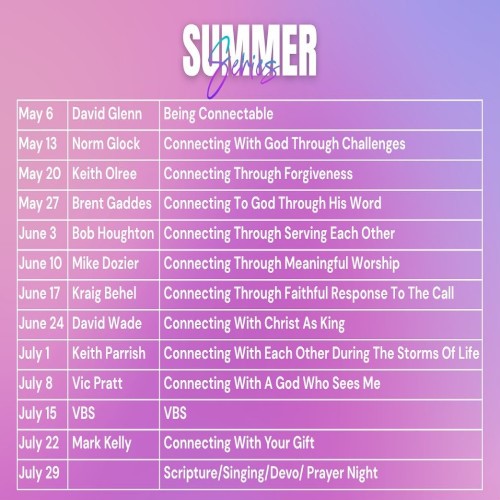
[00:00:37] Speaker B: tonight. We have the privilege of Craig Bill leading us in our study.
So Craig and Rita and their girls came to Madison in 2012. So it's been 14 years that we've had them a part of our church family here at Madison. And so what I usually do in and I guess have an opportunity to introduce one of our shepherds, I text usually the wife, the family, the kids to see if I can get any dirt to dig up any dark secrets. And certain ones, it's pretty easy to get things on. So one of the things I did this afternoon, though, additional to that is I asked Brandon, like, what are some things about Craig that you would like to share? And one of the things that he mentioned was about vbs and if you've never been here before around a vacation Bible school or maybe you have, you've just driven by, you'll notice there's always a massive sign out front and Craig usually is involved somehow with those signs. And Brandon had this idea many years ago, if I understand correctly, to make an enormous arc out front.
And Brandon shared the idea. People were like, no, we can't do it like that big. And Craig, oh yeah, we got this. And so he did that. And then they ended up using as kind of part of the learning center, if I understand. And Doug Cure was one of the people that kind of helped with that. And so I know he's worked on a lot of the mechanical parts of things there.
I also want to say I appreciate too just the way we've had different events. We've needed a hayride or something like that. He's always been willing to bring his tractor. And speaking of tractors, so Rita said that he only believes that something is a sport if it has a motor. Therefore he loves tractor pulls and drag racing. I did not know that. And she said, what attracted her to you was that tractor pool race where you were wearing your cutoff jean shorts.
So I made that one up. All right.
But the other part was that he loves a good one liner and most of those come from Bugs Bunny. And she said, I didn't realize that he was quoting that until years later. In our marriage, he enjoys all genres of music, especially ones that have a great drum beat. And he taught our girls air drumming at a very early age. But no, I really do appreciate Craig. And one of the things that I love about him and Rita is the way that they are so good and intentional about ministering to our kids and through MKC and so many different things. But also, Craig is an excellent Bible class teacher. If you've ever had the opportunity to sit in one of his classes, you will really enjoy it. He loves to study God's word and to dig into his word and also kind of the context behind things. And I'll never forget when he taught our Primary Connector Faith builders class back when I was a faith builder. And one of the things that I remember is like, we kind of started that, that whole course with, you know, everybody kind of knowing each other a little bit. But by the very end, we knew each other really well. And so he has a heart for community and connecting other people. So I'll turn it over to you and you can talk more about connecting.
[00:03:46] Speaker C: Well, I guess thank you, Andrew, for that introduction.
I told him earlier I was walking around. I was. I took off work a little bit earlier today so I could finish the lesson up and saw my wife walking through the house with her phone. And she said, when did we come to Madison?
I said, 2012. And she starts texting. I said, who are you texting? She said, andrew, I said, oh, for the record, I have never worn cut off jean shorts. Okay? Just for the record.
And I apologize for that visual that you have.
I'm sure some of you threw up in your mouth a little bit, so I apologize for that.
But it's a privilege to be here tonight. We're going to be talking about connecting through a faithful response to the call. I think this is the longest lesson titled of any of the ones that we've had so far. And it's a lot of slides, so we've got a lot of material to go through. But in particular, what we're going to be talking about is connecting with each other.
Connecting with each other. And I just want to say, you know, putting together a lesson like this, I mean, I taught Bible class, but this is kind of a little bit different venue, let's say. And I really appreciate the time and effort that Brandon and Andrew put into this, and they do a great job here of glorifying God as they impart the word to us. And the church said amen. All right, so a little bit of a week. Amen. But I'm going to need your participation tonight as we go through the lesson. And I want to do your. I'm going to have your participation in two things. Number one, we're going to talk about direction, and then we're going to talk about a question. Okay. So in direction, as I said, we're going to be talking about connecting to each other through a faithful response to the call.
But we're going to do that by going backwards through this lesson. So everybody say backward.
Backward. Okay, good. So a little bit of crowd participation. Don't be bashful. There's nobody here but us and the Lord. Okay. But don't be bashful about that. So our beginning is the end, and our destination is back at the start. So we're going to go backward. Everybody say it again. Backward through this lesson. Okay? All right, so there you go.
Jesus invited a little child to stand among them. This is Matthew, chapter 18.
And he said, truly, I tell you, unless you change and become like little children, you will never enter the kingdom of heaven.
And a favorite question of little children, you can probably guess it is why. Good. All right. So the question of the evening is why? All right, good job. So we're going to do this. Instead of going forward, we will go backward. And the question of the evening is why? Very, very good. I love this. This is going to be awesome. Maybe this will help you stay awake. Okay. All right, so let's talk first about the call.
We're connecting with each other through a faithful response to the call.
So in these, the synoptic gospels, Matthew, chapter nine, Mark, chapter two, and Luke, chapter three, Jesus made this statement. He said, I have not come to call the righteous, but I've come to call sinners to repentance. The call is for sinners only. And the question is why?
Why?
Well, Paul tells us In Romans, chapter three, verses 10 to 12, he says, as it is written, there is no one righteous, not even one. There is no one who understands. There is no one who seeks God.
All that's inclusive of everybody. Now, all have turned away from. They have together become worthless.
There is no one who does good, not even one. So when we ask the question, why did he call sinners?
Because that's what Everybody is.
All of us are sinners. That's the only people he had to call. Okay, so let's talk a little bit more about some characteristics, if you will, of. Of this call. What is it? What describes it? How can we think about it? What does Scripture tell us about the call?
Well, Paul in his letter to the Galatians, said, this is a call to be free. Free from what?
Free from the old law. Yes, but free from sin and from the death that results from our sin.
Acts, chapter two and verse 39. All right, verse 38 is the one we quote a lot. But if you look at verse 39, it says the promise. The promise? What promise? Well, the promise that he just talked about. That is that gift of the Holy Spirit that's going to be given to you.
This promise is for you and for your children and for all who are far off.
For all whom the Lord our God will call.
So that call is a call to a promise. A call with a promise attached to it, if you will.
Ephesians, chapter 4.
Again, Paul speaking talks about the call of hope. And that is one hope. There is one Lord, one faith, one baptism, one hope. Okay, this is not a hope about things that we normally think about. I hope my team wins the game. I hope it rains, or I hope it doesn't rain. I hope it's cold, I hope it's hot, whatever. Those are things that wish based on a chance. That's not what biblical hope is.
Hope is a 100% ironclad guarantee because God's promises, he's always, always, always faithful.
Okay, First Corinthians, chapter one in verse nine, this call is a call to fellowship.
Now, in this context, called you into fellowship with Christ our Lord. The focus there is on Christ, but when he says called you, it's the aggregate, it's the group, it's all people. He's called all of us into fellowship, not only with Christ, but with each other.
So that call is a call to fellowship.
Colossians 3:15, Paul says it's a call to peace. Let the peace of Christ rule in your hearts. Since as members of one body, there's that idea again of the aggregate. You were called to peace. And then look what he says. Be thankful for that. Be thankful that you can answer that call to peace.
And this is one we're going to spend a little bit of time on as we go through second Timothy 1:9, a call of grace.
Paul says to Timothy, God saved us and called us to a holy calling.
Look what it says. Not because of Our works, but because of his own purpose and grace, which he gave us in Christ Jesus before the ages began.
So it's a call of grace, not works. But the question is why?
Why is it a call First Peter? We're going to come back to that in a little bit. First Peter, chapter two and verse nine says, this is a call to be different.
This is a familiar passage to you, but you are a chosen people.
King James says, peculiar people.
I fit that bill, right? You can tell by the introduction.
A royal priesthood, a holy nation, a people for God's own possession to proclaim the virtues of him who called you out of darkness into his marvelous light. The church, the organization of the church, the body that Christ came to build, built it on the confession that Peter gave the church is this group of people. It's the ecclesia, the called out ones. We talked about this a few quarters back when we studied the church from Acts, chapters one through 12. So this ecclesia, this group, this congregation is part of the called out people.
Now, this passage is one I think is very important. So in the past, if you had asked me, where would you point people to talk about the plan of salvation? Notice that the call is God's plan. This is not accidental. It's not off the cuff. It's not something that was not.
That was just thought up on the spur of the moment. It's been his plan.
It's been his plan from eternity.
Okay? And it used to be that if you ask me, well, where would I go to find the plan of salvation? I'd point you to Acts, chapter two in verse 38.
But I think, as somebody said, that emphasis is on the wrong syllable, right? I think the emphasis, at least from my perspective, is on the wrong thing.
This is the plan.
Acts, chapter 2, verses 22 and 23. Peter in his sermon there on the day of Pentecost, says, men of Israel, listen to this message.
Jesus of Nazareth was a man certified by God to you, by miracles, wonders and signs, which God did among you through him, as you yourselves know, he was delivered by God's set. Look what it says.
God's set, plan and foreknowledge. And you, by the hands of the lawless, put him to death by nailing him to the cross. But God raised him from the dead, releasing him from the agony of death because it was impossible for him to be held in his clutches. Okay, so this is the plan.
What's in Acts chapter 2 and verse 38. It is the prescribed response to that plan.
It's what we need to do in response to that plan. Okay, now let's talk about. We've. So we've looked at some characteristics here about this call.
So let's consider a couple of points as we think back through those things.
There are a couple of things that stand out to me that I want to point out to you.
And the first one is we've already kind of mentioned a little bit, is that of the scriptures that we've looked at refer to people in the aggregate. Now, does God look for individuals? Yes, he does.
But the church is a group. It is a group of called out people.
So notice that all of these refer to people in kind of what I would call the aggregate or a group mentality. Notice we talked earlier Jesus statement, He calls sinners plural to repentance. How many are sinners?
Everybody.
Okay, so it's this idea of the group. The second thing that we notice about these scriptures is that they focus on God's blessing for us. We go back to this, the passage in second Timothy where he said, we're called through his grace.
We're called through his grace, not our works.
Right? That's not the important part. It's the grace. So we might ask the question, what is it?
Why?
Why?
Well, God desires a connection between he and us individually and collectively, but he also desires a connection between each of us together.
Right? Hebrews chapter 10, verses 20, verse 24. Stir up each other to love and good works.
God's call requires a response of faith, not merit.
Let me say that again. God's call requires a response of faith, not merit. Again, second Timothy, chapter one, verse nine. God saved us and called us to a holy calling that is set apart not because of our works, but because of his own purpose and grace, which he gave us in Christ Jesus before the ages began. That's been the plan all along.
We just have to respond to it.
All right, so now we've talked about the call. Let's go on and think about that. Remember, we're going not forward, but okay, great participation. Let's go. We're not going forward. We're going backward through this lesson.
So we talked about the call, and now we're going to talk about the faithful response to that call.
Now we think about, well, what is faith?
Well, From Hebrews chapter 11, we have a definition there of what is faith? Faith is assurance and certainty. Assurance and certainty, Right. Different translations, substance and evidence. Okay, Same, same. Different words for the same thing. Assurance and certainty. That's what Faith is.
Hebrews 11:1:3. Now faith is the assurance of what we hope for.
Assurance of what we hope for. Not a wish on a chance, but it's a guarantee of our hope. Okay. And the certainty of what we do not see.
This is why the ancients were commended.
Notice this emphasis.
This is why the ancients were commended. And you're going to see, if you read that chapter, you'll see the list of ancient people, people that had lived and died long before this was written.
You'll see that list there. And it says, this is why they were commended.
Now, the chapter goes on to talk about their deeds and that kind of thing.
But their deeds were not what commended them. It was the faith that they had. By faith we understand that the universe was formed at God's command so that what is seen was not made out of what was visible.
Again, it is assurance and certainty.
There's a lot there. But the one thing that's not there is what I do.
Okay, let's keep going. Faith is our link to the mind, the spirit and the presence of God.
How? How so? It is because God gave it to us.
Faith is not something we make up. Faith is not something I just pull out of thin air. It comes from his word put into our hearts. That's where it comes from. It is our link to God's mind, His spirit and his presence in our lives.
And faith is the conduit through which grace is given to us for our salvations. Look at Ephesians, chapter 2.
See what Paul says here. For by grace you have been saved. Through what?
Through faith. Okay.
That grace comes to us through. Through this conduit, if you will, of faith. It is a gift of God.
Now, if you go and read commentaries on this, what you'll see is that the. It is the gift of God not only applies to the grace, certainly that's true, but it also applies to the faith.
Now, what does that mean? We talk about faith in Jesus, but this and other passages, if you read them closely, effectively, say it is faith of Jesus.
What does that mean?
Faith is not really mine. I don't get to make it up. It comes from God. We'll look at that a little bit more. It's not a result of works so that one may boast. It's not about what I do.
For we are his workmanship. Created in Christ for what? For good works. You noticed every time that God says something that he does, you know, in the first chapter of Genesis, God created whatever and it was good.
Right.
Notice the good works are prepared by God.
This book that we believe in. We sang about it just a minute ago. The Bible that we believe in is chock full of good works that we can do.
Who prepared them?
God did.
Not something I made up, not something from me.
I'm just following what he told me. Okay, that we should walk in them.
We should be involved in the good works that God has prepared for us to do.
Okay?
So this faithful response that we're talking about, we have to understand something. God provides everything.
Everything.
What does he provide? He provides that grace that we talked about that covers a multitude of sins. He provides the faith.
The faith that we have in Jesus is the faith that of Jesus. He provides that salvation.
It's a gift of God. It's that same gift. And even down to the works that we are expected to do.
Those good works, guess where they come from?
Scripture tells us they come from God. They were prepared by God beforehand, in eternity, backwards, before the beginning of time. He's had that. For we are his workmanship, created in Christ Jesus for good works in order that we might do good works. Why? Because we are responding to what God has done for us.
This is not merit.
This is response.
All right, James, chapter two. Now don't go out of here and say that Craig Beals said that works are not important. I didn't say that.
That's not what I said. James, chapter two. So also, faith by itself, if it does not have works, is dead.
But someone will say, you have faith and I have works. Show me your faith apart from your works.
What's the answer? I can't do that because the faith is not mine, Jesus. It's the faith of Jesus. And I will show you my faith by my works or through my works. Okay? When we understand that we are not doing these good works as a function of merit to God, and we understand that we are doing them out of a faithful response to everything that we looked at that God gave us, including the faith, then we can begin to understand what our purpose here is. Okay, now you say, how does this relate to connecting? We're going to get there, all right? So we're not going forward. We're going backward through this.
All right? God, as we said earlier, wants a relationship with. With us, but he also wants us to have a connection, a deep connection with each other.
Question is, why? Why does he want us to have that connection?
Well, look at John 13:34, 35, a new commandment I give you.
Love one another as I have loved you, so you must also love one another by this.
By what?
By this Love that you have for one another that mirrors or is an image of the love that I have for you. By this love for one another, everyone will know that you are my disciples.
Okay, so that begs the question, how are people going to know that we are his disciples? How are we going to know that? How are they going to know that our lives have been changed? How are they going to know what God has in store for them? What's their first clue going to be?
It's going to be our connection to one another.
Okay, that puts a lot more, I'll say, burden on us. That's not really the word I'm after, but that's the one that came to my mind. It puts a lot more responsibility, I'll say that on us to be connected and love each other like Christ loved us.
Because that is the first view that people are outside the church are going to get of what it means to be a follower of Jesus. That's a big responsibility.
That's a huge responsibility on us. That's the reason. That's why. All right, now here's an interesting passage. If you want to turn to Luke chapter 17, and let's look at verses 5 to 10. Okay? This is a very interesting story here.
Jesus in an interaction he had with the apostles. Okay?
And just to give you some context, this occurs just after Jesus tells his apostles to forgive others.
Always.
Right? Always be forgiving.
If somebody sins against you, you forgive them. If they do it again, forgive them again. If they do it again, forgive them again.
70 times 7.
Right? That's what Jesus told Peter. Right? 70 times 7.
That is the context. And then look at verse 5 and see what it says. The apostles said, increase our faith. Now, there seems to be a little bit of debate in the things that I've read. Why did they ask this?
A lot of scholars say that the reason they ask this is because they looked at this idea, same problem. Maybe Peter had that. You mean I'm supposed to forgive my brother every time?
That's hard. Okay, well, maybe if you can increase our faith a little bit, we can accomplish this task.
Let's read what they say. What Jesus response here was, the apostle said to the Lord, increase our faith.
And the Lord said, if you had the faith, like a grain of mustard seed, you could say to this mulberry tree, be uprooted and planted in the sea, and it would obey you.
All right, we've all heard that before. Right?
And that's usually where we stop.
But I don't think that's the end of the response. And I'll show you why. Let's read on verses 7 through 10.
Will any of you who has a servant plowing or keeping sheep, say to that servant, when he has come in from the field, come at once and recline at the table?
So this is a master talking to a servant. You come in from doing your job. Does he say, come in at once and recline at the table?
Will he not rather say to him, that is the servant, prepare supper for me.
This is the master talking. You prepare supper for me. And you dress properly and serve me while I eat and drink. And afterward you will eat and drink.
Does he thank the servant because he did what was commanded of him?
So you also, when you have done all that you are commanded, say this.
We are unworthy servants. We have only done what was our duty to do.
Now, when I look at that and I see the question or the request that the apostles made to increase our faith, and then this is the response you get at first glance. Does that increase your faith?
You're an unworthy servant. Even if you do everything I tell you to do, how does that increase your faith?
Well, I think what Jesus was trying to do here was let them know and let us know by proxy the separation that there is between his deity and our humanity.
That separation is immense.
We do not know what God's thoughts are. We don't understand what his ways are. There are none righteous. Righteous? No, not one.
Okay, that's something we have to understand.
Okay. Why?
Well, again, God provides everything we need. Grace.
The grace that we need to cover our sins. That unmerited favor, that thing that gives us something that we could not get for ourselves.
The faith that we have is a gift of God, faith of Jesus.
The salvation that we can obtain through this faithful response is the gift of God.
Even the good works that we are called to do are a gift from God, provided by God, prepared before the beginning of time for us.
The only thing, the only thing we have to offer is a devoted response of faith.
He doesn't need our works, but he uses our works to accomplish his will.
Okay, but they are not meritorious for our salvation. What gives us that? Salvation is everything that God provides.
And then we have to accept it.
Okay? It is a free gift.
So God has set us up for connection.
Set us up for connection. What does that mean?
That means he's given us the environment, the gifts that we need to connect to one another.
Again, why? Why do we need to connect to one another?
Well, it's for our benefit. We can build each other up. We looked at Hebrews chapter 10, verse 24. Stir up each other to do the very things that he has prepared for us in those good works.
But again, the primary thing that we see is that the first thing that people outside of the fold see is our love and devotion to one another.
It's a huge responsibility.
Now, he set us up for that. How so?
How so? We are all the same.
We're all in that group that he talked about, the ones, the very ones he called the sinners, called to repentance. Every single one of us is in that group, right? There's nobody that's left out of it. We're all the same, okay?
We receive the same grace when we step up to the plate and we go through the prescribed response that we talked about in Acts chapter 2, in verse 38.
We get that salvation as a result of our response. Not our merit, but our response to the call.
We all receive the same grace. We are all unworthy servants. Even our good works, as we said, are a gift from God.
They don't come from us, they come from Him. And all we can do is offer to do them at his request.
So what keeps us from connecting?
What keeps us from connecting? Like I said, God has set us up for this connection.
He set us up and he reminds us through the things that we've looked at, all of you have been called and you're all the same.
And this call, the things that you receive, the things that even that you do as a result, as a result of your response to that call, all come from God, right? So we're all at the same level.
So what does that mean? Comparisons between ourselves are useless.
Useless.
They don't mean anything.
I don't need to compare myself to you.
And if I do, you know what we're going to find out?
We're all sinners. We're all unworthy servants, right?
I don't know. Maybe that's depressing to you. It's a little bit comforting to me because it says I don't have to worry about how I compare to you because I already know that we're all the same.
That makes it easier when you have the same level, the same interest, the same commonality of things. Is it easier to connect when you realize that?
Up and down for yes, sideways for no. Yeah, it's easier to connect when you have some commonality there. Well, boy, we got it in spades, don't we?
Okay, so comparisons between ourselves are useless, right?
And it always bugged me that we use the parable of the talents as if those were talents. I think it's different than that. But that's a discussion from another time.
But who among us doesn't want to be the five talent man?
God gives us everything.
Everything that I have, every spiritual gift that you have is not from you, is from God.
So comparisons between ourselves is useless. Tearing each other down and gossip is disconnecting, isn't it?
When we engage in those behaviors, it disconnects us from one another.
Guess what?
It also disconnects us. From who?
From God himself.
Right. So these comparisons, the backbiting, the gossip, tearing each other down is disconnecting. That's the precise opposite thing of what God is calling us to do. He's calling us to connect to one another and show that love for each other so that when we. When people outside see us, that's the first thing they see. That's how they're going to recognize Jesus in this place is because of the love that we have, the connection that we have for one another. So how do we do this?
Hebrews chapter 12 and verse 2. Fix our eyes. Where? On Jesus. Guess what? If my eyes are looking up at Jesus, who are they not looking at to make a comparison?
The people around me.
So I need to keep my eyes fixed on Jesus.
Why? So that we can stir up one another to love and to good works. Hebrews chapter 10 and verse 24.
We need to treat each other like we would treat Jesus. Now we all know the golden rule. Treat others as you would have them treat you right?
Well, Matthew chapter 25, where Jesus is saying, hey, I was sick and you visited me. I was hungry and you gave me food. I was thirsty and you gave me something to drink.
And they said, well, Lord, we've never seen you like that. What did he tell them?
He said, when you do that to your brothers and sisters, when you do that to your community, when you treat them like you would treat me, then you've made the connection, okay?
Not just treat everybody like you want to be treated. You need to treat people. We need to treat people like we would treat Jesus. Jesus walks in that door, how are we going to treat him?
How are we going to treat him? Jesus, come sit here. Jesus, do you need anything? What can I do for you? I love you. I can serve you. What can I do?
We treat other people like that.
We're going to make a connection, okay? Forgive always. Keith Olre talked to us a few weeks ago about the idea of forgiveness and how forgiveness is as much for Us as it is for the person that we forgive. We already looked at it. Forgive how often? All the time.
Why?
Why?
Because Jesus forgave us. How did Jesus forgive us?
How does he forgive us? Every time we ask, we do it again. Does he forgive us? Yep.
Oh, I did it again. Does he forgive me? Yep.
Every sin that a husband commits is not against his wife. Every sin that a wife commits is not against her husband. Every sin that members commit is not against every other member. But every sin we commit is against God.
It's against God. So how can we not forgive when he is so free to forgive us?
Forgive always. Colossians 3:13, and then in Colossians 3:14.
Put on love.
Put on love.
If we are going to connect with each other, part of that faithful response is we have to love each other.
And loving each other starts with realizing that we're all the same.
There's not a difference between me and you.
There's not a difference between any of you out here. We're all the same. Okay, so I'm going to leave you with this. If if you find yourself struggling to make connections, if you find yourself falling victim to gossip, if you find yourself feeling disconnected from others, if you feel yourself not making the effort to connect to others or comparing yourself to others in a way that basically tries to step over one another or to tear each other down, the question you have to ask yourselves is, what is it?
Why?
Let's bow together.
Our gracious Father, we thank you.
We thank you that you've given us this call, Father. We pray that we respond to it faithfully.
Father, help us to understand our condition relative to your goodness. Help us to understand that we are all sinners.
Help us to understand that comparisons between ourselves are useless and even destructive.
But, Father, help us to treat each other as we would treat you.
Father, help us always to forgive, to stir up each other to love and good works.
Father, help us to put on love, the same kind of love that you have for us.
And by faithfully responding to your call, let us connect to one another so that we can do your will in this place and spend eternity with you because of the faith that you give to us.
Help us to do those good works that you've given us to do, and respond every day in the way that you would have us respond with faith.
Forgive us. Keep us in your care. We pray in Christ's name. Amen.
Thank you for your attention.